Portfolio vs Resume: What Matters More for IT Freshers in India?
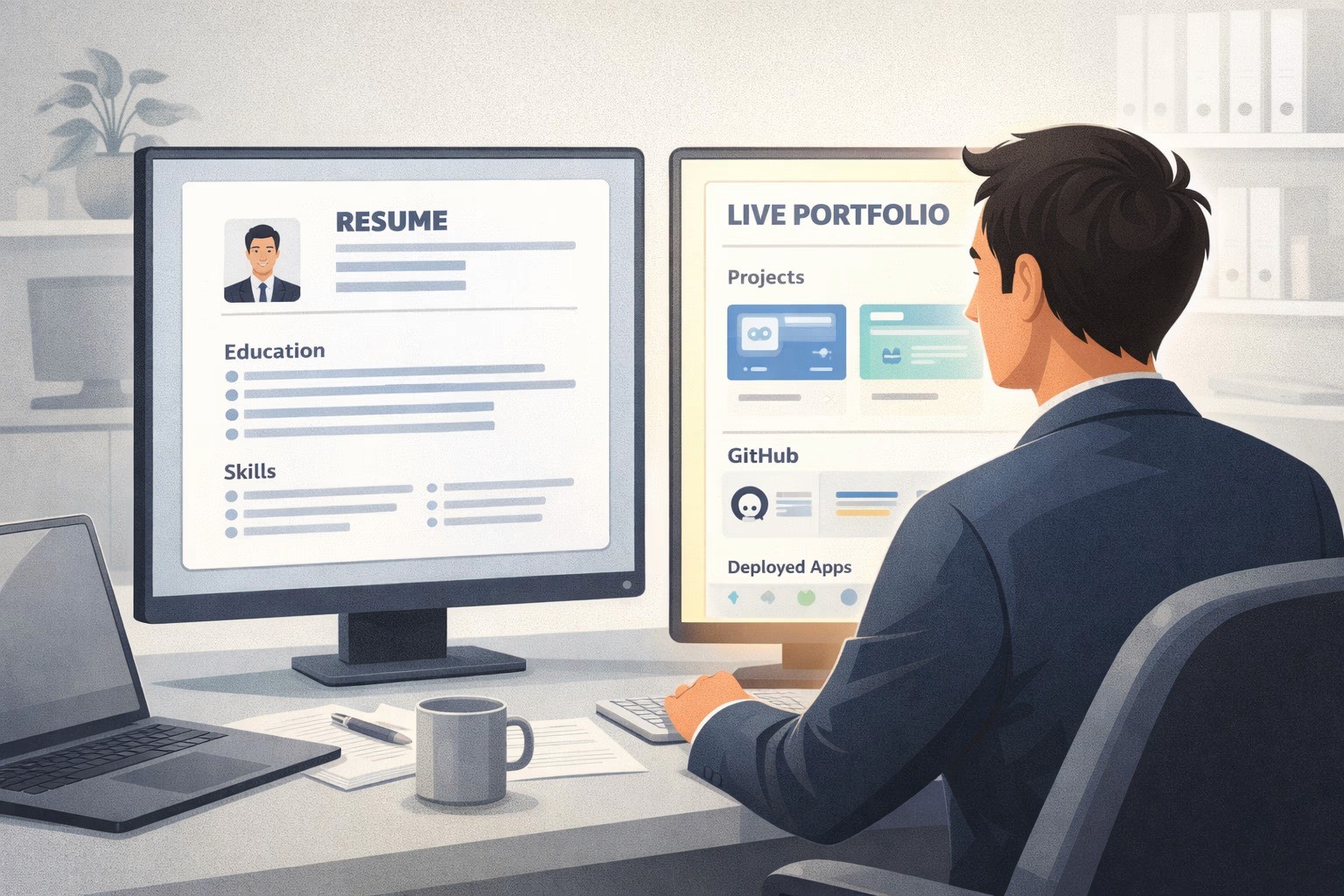
What Recruiters Really Look?
For IT freshers in India, job hunting has changed. Recruiters no longer rely only on degrees, marks, or certificates they want to see what you can actually build and explain.
This has created a common question among freshers:Portfolio vs resume – what matters more?
The honest answer is simple: 👉 Your resume gets you shortlisted. Your portfolio gets you selected.
Understanding this balance is critical for both campus placements and off-campus IT jobs.
The real answer : You need both
If you’re a fresher in India, here’s the truth.
A resume helps you get seen (especially in campus drives and HR screening).
A portfolio helps you get trusted (especially in technical rounds and off-campus shortlisting).
Your resume opens the opportunity. Your portfolio proves you deserve it.
What is a resume (in simple words)?
A resume is a one-page summary of:
your skills
education
projects (brief)
internships (if any)
tools and technologies
Recruiters use resumes because they need to scan fast. In India, many companies get hundreds or thousands of fresher applications for the same role. So the first filter is often quick.
What is a portfolio?
A portfolio is your proof of work.
For IT freshers, portfolio usually means:
2–3 strong projects with proper documentation
code + screenshots + demo video (optional)
clear problem statement and features
clean folder structure
readable code
A portfolio can be:
GitHub repositories
a personal project website
a simple demo page for your app
a document that shows project architecture and result
Why this matters in India right now
In India, a lot of students have similar degrees and similar course certificates. So recruiters depend more on what they can verify quickly.
Also, many companies use software systems to manage applications (ATS-like tools are very common in large-company hiring). That makes resume formatting and keywords important for visibility.
At the same time, skill gaps are still a big issue for entry-level hiring. Companies keep pushing for job-ready skills and real project experience.
What recruiters check first: campus vs off-campus
Campus hiring (college placements)
In campus drives, the resume is usually checked first.
Because:
shortlisting is fast
criteria is standardized
recruiters compare many students in limited time
But once you reach technical rounds, your projects get questioned. That’s where a portfolio helps.
Off-campus hiring (direct applications)
Off-campus is more competitive. Here, a portfolio often becomes the big differentiator, because:
many applicants look same on paper
technical teams want proof of coding and project work
portfolios reduce guesswork
Service companies vs product companies: what changes?
Service companies (freshers)
They often want:
basic coding + SQL basics
ability to learn fast
project readiness (can you work in a team setup?)
So your resume should be clean and keyword-aligned but your portfolio should show practical work: CRUD apps, APIs, testing frameworks, simple dashboards.
Product companies (freshers)
They usually care more about:
problem-solving
code quality
project depth
Here, the portfolio carries more weight in technical evaluation. A strong project can outshine a long resume.
Resume vs Portfolio: what each one is best at
Resume helps with:
getting shortlisted faste
passing first-level screening
showing skills in a clean snapshot
Portfolio helps with:
proving you can build things
showing real coding ability
giving interview topics (architecture, bugs, decisions)
Simple rule:
If your resume claims “Java + Spring Boot”, your portfolio should show a working project that proves it.
The best approach for freshers:
Build your “Minimum Job-Ready Pack”
Resume (1 page)
role-focused headline (example: Full-stack fresher | Java / MERN)
6–10 strong skills (only what you can explain)
2–3 projects (impact + tech + result)
internship (if any)
Portfolio (2–3 solid projects)
Pick based on your target role:
Backend (Java/.NET): REST APIs, auth, DB, validation, error handling
Full-stack (MERN): login + CRUD + dashboard + clean UI
Frontend: Responsive user interfaces + seamless API connectivity + effective state handling
QA: automation framework + test reports + sample cases
Data: clean dataset work + analysis + charts + clear findings
DevOps: containerized app + deployment steps + CI/CD demo
Common fresher mistakes
Resume mistakes
too long (2–3 pages)
generic skills list
no clear role focus
projects written like college practicals
Portfolio mistakes
unfinished repos/projects
no README or setup steps
copied projects with zero understanding
messy code and random folder names
Fresher checklist: what matters more depends on the stage
Use this simple checklist:
Before shortlisting: Resume matters more ✅
During technical interview: Portfolio matters more ✅
For off-campus visibility: Portfolio matters more ✅
For campus screening: Resume matters more ✅
For final confidence: Both matters equally ✅
Final takeaway
If you’re an IT fresher in India, don’t choose one and ignore the other.
Build a clean resume to get shortlisted. Build a strong portfolio to prove you deserve the role.
Join WhatsApp Groups for Updates
Group 1: CLICK HERE> https://chat.whatsapp.com/KAXuSLpag96DcdMDsphFrO
📢 Don’t forget to forward this message to your friends and help them kick-start their careers