AI vs Human Judgment in Hiring Decisions
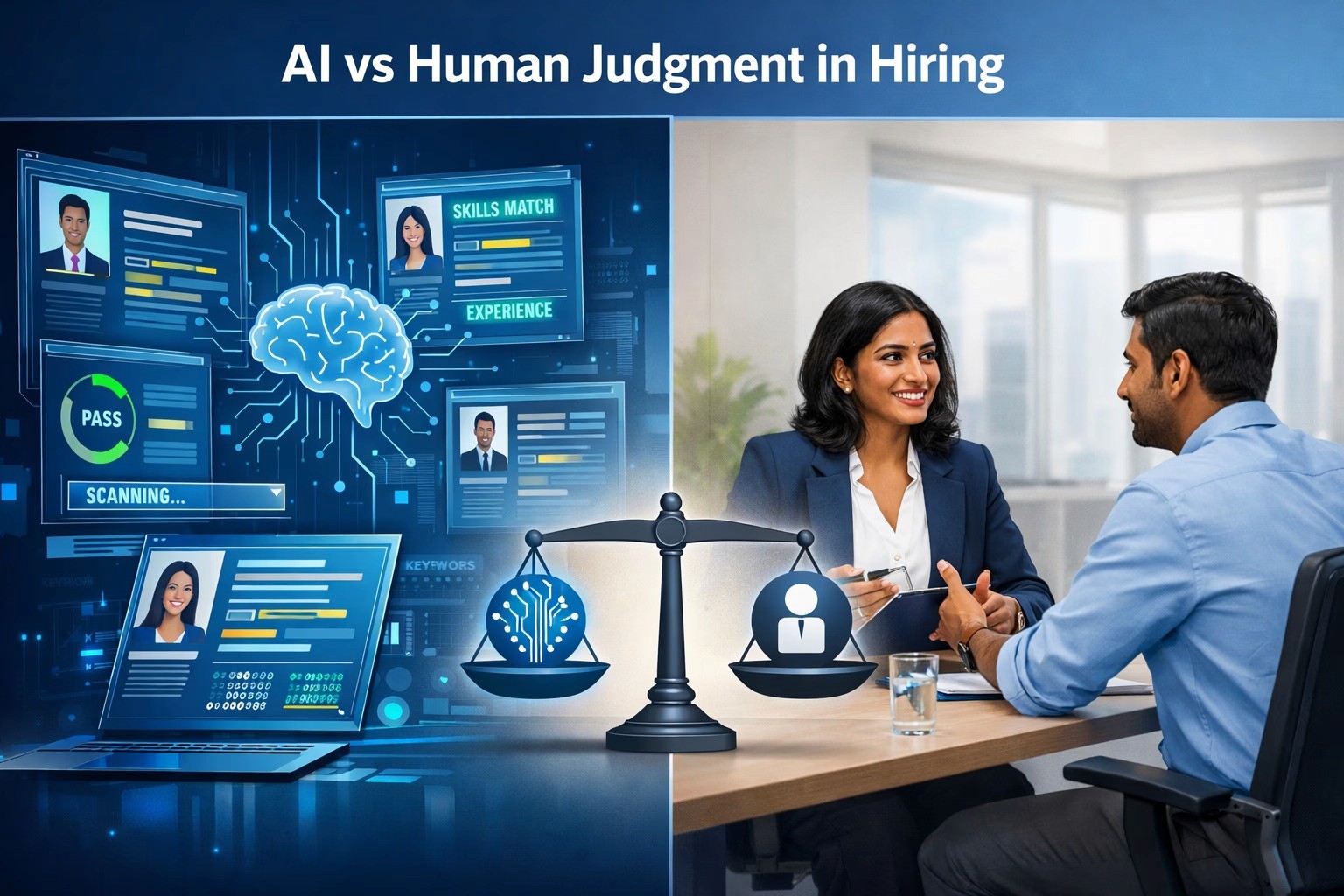
A few years ago, most job seekers believed hiring was simple. You prepared your resume, attended interviews, answered questions, and waited for the final result. But today, the process feels different. Many engineering graduates and IT freshers now hear terms like AI screening, ATS filters, automated assessments, and skill-based hiring.
This naturally raises an important question:
Is AI deciding who gets hired, or does human judgment still matter?
For students preparing for jobs in India’s IT hiring ecosystem, this is not just an interesting topic. It is a practical career question. Understanding how companies hire today can help freshers prepare in a smarter way.
Why AI Is Becoming Common in Hiring
Hiring at scale is difficult. When a company opens a role for freshers, it may receive hundreds or even thousands of applications. Recruiters cannot manually study every resume in detail at the first stage.
That is where AI and automation come in.
Today, many companies use technology to help with:
resume screening
keyword matching
application ranking
online assessments
interview scheduling
basic communication with candidates
This does not mean the entire hiring process is controlled by machines. It simply means AI helps reduce the first level of manual effort.
In simple words, AI helps companies manage volume, especially in campus hiring, bulk hiring, and entry-level recruitment.
What AI Can Do Well in Hiring
AI is useful in hiring when the task is structured and repetitive.
For example, it can quickly identify whether a resume includes:
required skills
relevant programming languages
certifications
project keywords
education details
internship experience
It can also help conduct standardized online tests and compare performance across many candidates.

This improves speed. It also helps recruiters avoid spending too much time on profiles that clearly do not match the role.
In large hiring environments, this kind of automation is practical.
Where Human Judgment Still Matters
Now comes the part freshers must understand clearly.
Hiring is not just about matching keywords. Good companies do not hire people only because a resume contains Java, Python, SQL, or testing tools. They hire based on whether the candidate can actually contribute in a real work environment.
That is where human judgment becomes critical.
A recruiter, hiring manager, or technical interviewer looks beyond the resume. They try to understand:
Can this person explain their project clearly?
Do they understand the logic behind their work?
Can they solve unfamiliar problems?
Are they trainable?
Will they work well in a team?
Do they show ownership, communication, and learning ability?
AI may detect information. But human judgment evaluates meaning.
A project written on a resume may look impressive to an automated system. But in an interview, a human can quickly understand whether the candidate truly built it or simply copied parts of it.
The Real Difference Between AI and Human Judgment
The easiest way to understand this is:
AI filters. Humans decide.
AI can shortlist candidates based on patterns. Human decision-makers assess potential, clarity, confidence, and practical thinking.
For example, two freshers may have similar resumes. Both may mention the same programming language, similar academic scores, and similar project titles. But during the interview, one candidate may explain trade-offs, challenges, and debugging steps with confidence, while the other gives memorized answers.
AI may treat both as similar. Human judgment will not.
That is why students should never assume that clearing an online screening round means the hard part is over.
Can AI Make Hiring Better?
Yes, in many ways it can.
When used properly, AI can make hiring more efficient. It can reduce initial screening time, organize large volumes of applications, and support structured assessments. It can also help companies identify patterns that might otherwise be missed in a large applicant pool.
For freshers, this can be helpful too. A well-structured resume with clear skills and relevant project details is more likely to get noticed.
But AI has limits.
It cannot fully measure seriousness, curiosity, discipline, communication maturity, or problem-solving depth. These are often the exact qualities that decide long-term career growth.
So the smarter way to look at modern hiring is this:
AI improves process efficiency. Human judgment protects hiring quality.
What This Means for IT Freshers
This topic becomes very practical when you think about your own job preparation.
Many students still prepare only for aptitude rounds or only for resume-based shortlisting. That is no longer enough. You now have to prepare for both systems:
1. Prepare for AI-based screening
Your resume should be clean, relevant, and keyword-aware. Mention actual tools, technologies, projects, internships, and certifications honestly. Do not fill your resume with random keywords just to look impressive.
2. Prepare for human evaluation
Be ready to explain everything you mention. If you wrote a project in your resume, understand the logic, design, challenges, and decisions behind it. If you mention SQL, be ready to answer SQL questions. If you mention testing, be prepared to discuss real testing scenarios.
This is where many freshers fail. They optimize for getting shortlisted, but not for proving capability.
Skill-Based Hiring Is Becoming More Important
One of the biggest shifts in the IT industry is the move toward skill-based hiring.
Companies increasingly want proof that a candidate can do the work, not just talk about it. That is why practical assignments, coding rounds, project discussions, portfolio reviews, and technical interviews remain so important.
This is also why industry-oriented training, practical projects, and structured learning matter more than ever. Students who practice real tasks tend to perform better in both AI-driven and human-led hiring stages.
So, Who Wins: AI or Human Judgment?
The real answer is neither.
Hiring works best when both are used properly.
AI helps companies manage speed and scale. Human judgment helps them identify potential and fit. One supports efficiency. The other protects quality.
For freshers, the lesson is simple: do not prepare only to pass a system. Prepare to prove your value.
A machine may scan your resume, but a person will still evaluate your readiness.
Final Thoughts
AI is changing hiring decisions, but it has not removed the importance of human judgment. In fact, as screening becomes more automated, the interview stage becomes even more important.
So if you are an engineering graduate, intern, or IT fresher, focus on what truly matters:
build real skills
work on practical projects
learn to explain your work clearly
prepare for both automated screening and real interviews
That is the smartest way to grow in today’s hiring environment.
For students who want stronger job readiness, structured learning with practical exposure can make a real difference. Training approaches that focus on skills, projects, and industry expectations, like those encouraged by VibrantMinds Technologies, can help freshers become more confident and better prepared for the real hiring world.
Conclusion
AI may help shortlist resumes, but it does not replace real capability. Human judgment still plays the final role in identifying who is ready to learn, contribute, and grow.
So instead of worrying about whether AI or humans are deciding your future, focus on becoming the kind of candidate both will recognize as valuable.
That is how strong careers are built.


