Prompt Engineering: Is It a Real Career Skill?
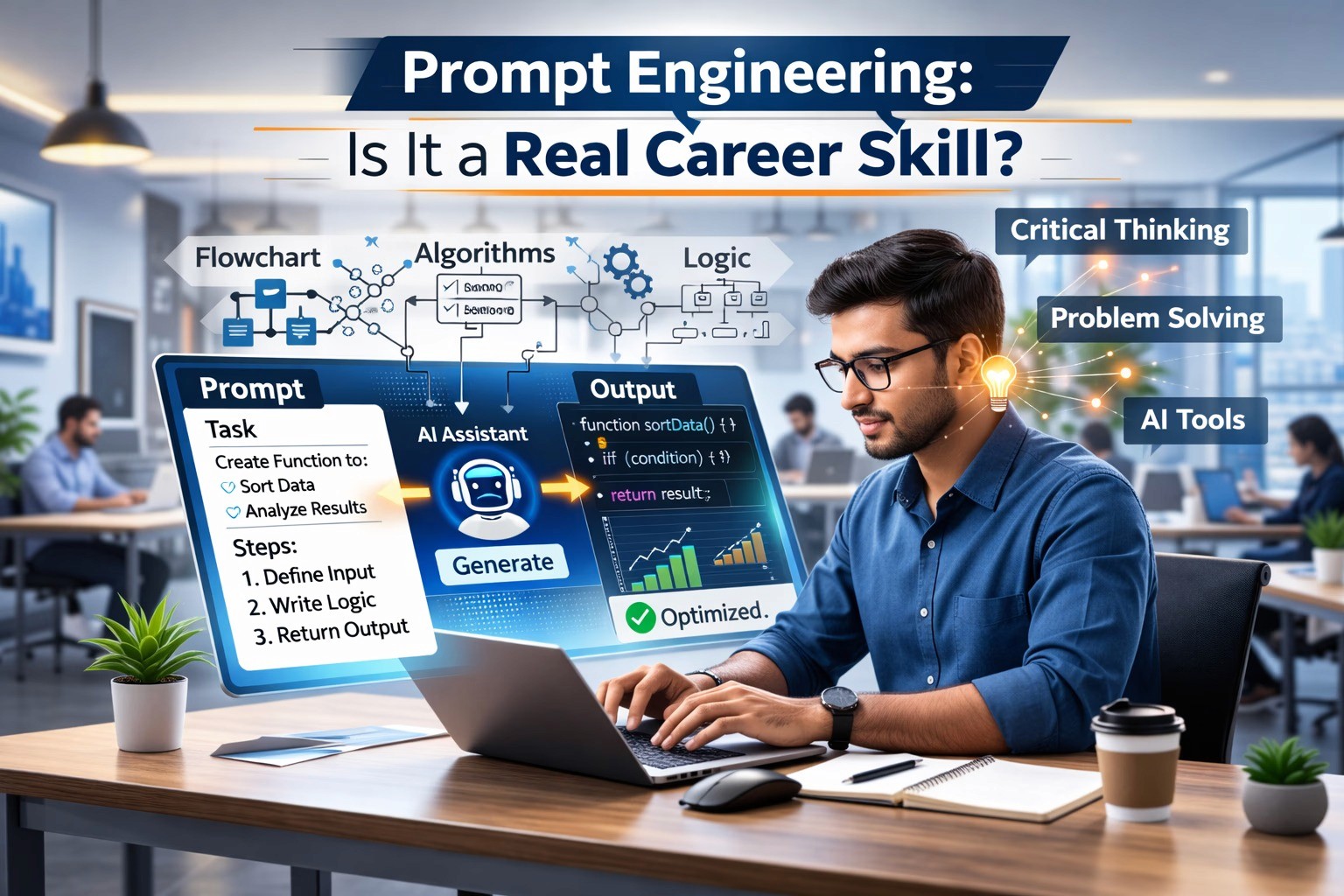
A year ago, many students believed prompt engineering would become the next big standalone career. The excitement was understandable. AI tools were spreading fast, companies were experimenting with ChatGPT-style workflows, and social media made prompt writing look like a shortcut to a high-paying tech role.
But the real industry picture is more practical.
If prompt engineering is considered as a real career skill but that fact is, it is not enough. It is becoming more valuable as part of broader AI skills, problem-solving ability, domain understanding, and software workflow knowledge and here lies the opportunity.
What is prompt engineering in simple words?
Prompt engineering means giving clear, structured instructions to an AI model so it produces better results. That may include asking for code, test cases, summaries, documentation, SQL queries, debugging help, or content drafts.
In real work, this is not just “typing better questions.” Good prompt engineering often involves:
defining the task clearly
adding the right context
setting constraints
checking output quality
refining instructions based on results
That makes it useful in software development, testing, support, analytics, content, and business workflows.
In today’s AI-driven world, one term that has gained massive attention is Prompt Engineering. From LinkedIn discussions to campus conversations, many engineering students and IT freshers are wondering:
👉 “Is prompt engineering a real skill I should learn for my career?”
Let’s explore this topic in a practical, industry-focused way, so you can make the right decision for your future.
Why Is Prompt Engineering Becoming Popular?
The rise of AI tools like:
ChatGPT
GitHub Copilot
Google Gemini
has changed how developers work.
Today, developers use AI to:
Generate code faster
Debug errors
Write documentation
Understand new concepts quickly
Because of this, the way you ask questions to AI matters a lot, which is why prompt engineering is gaining attention.
Is Prompt Engineering a Real Career Skill?
Here’s the honest answer:
👉 Yes, but not as a standalone career skill for freshers.
What It Is NOT:
Not a full-time job role for beginners
Not a replacement for programming
Not enough to get hired
What It Actually Is:
👉 A supporting skill that improves your productivity.
Think of it like:
Better Google searching
Efficient debugging
Smarter learning
How IT Companies Actually View It
In real IT companies, your job is to:
Solve problems
Build applications
Handle real-world scenarios
Even if AI generates code, you still need to:
Understand logic
Fix bugs
Handle edge cases
Ensure security
👉 AI assists — but you are responsible for the final outcome.
That’s why companies still prioritize:
Programming skills
Problem-solving ability
System understanding
Where Prompt Engineering Actually Helps
1. Faster Learning
Freshers can use AI to:
Understand concepts quickly
Get examples
Break down complex topics
This makes learning more efficient.
2. Writing Better Code
With good prompts, you can:
Generate structured code
Explore multiple solutions
Improve code quality
But always review and understand what you generate.

3. Debugging Errors
Instead of struggling alone, you can:
Share error messages
Ask for explanations
Get step-by-step fixes
This saves time and improves learning.
4. Building Projects
Prompt engineering helps in:
Planning project structure
Writing modules
Generating documentation
This is especially useful for beginners.
The Biggest Mistake Freshers Make
Many students misuse AI by:
❌ Copy-pasting code without understanding
❌ Depending fully on AI
❌ Ignoring fundamentals
This becomes a problem during interviews.
👉 Interviewers will ask you to explain your code.
If you cannot, your chances of selection drop significantly.
What Should Freshers Focus On?
To build a strong IT career, follow this order:
1️⃣ Core Skills (Top Priority)
Programming (Java, Python, JavaScript)
Data structures and logic
Basic system understanding
2️⃣ Practical Projects
Build real applications
Solve real problems
Show your thinking process
3️⃣ Use Prompt Engineering as a Tool
Use AI to:
Learn faster
Improve productivity
Build better projects
👉 Not as a shortcut, but as support.
How to Learn Prompt Engineering Effectively
Step 1: Be Clear in Instructions
Always define what you want, including context and expected output.
Step 2: Practice Daily
Use AI while coding, learning, and debugging.
Step 3: Ask Better Questions
Instead of asking for direct answers, ask for explanations, improvements, and edge cases.
Step 4: Validate Everything
Never trust AI blindly. Always verify outputs.
Future of Prompt Engineering
Prompt engineering will definitely remain relevant.
But it will evolve into:
👉 A basic skill every developer should have, not a separate job role.
In the future:
Developers will work closely with AI
Productivity will increase
Problem-solving will matter even more
Conclusion
Prompt engineering is a real career skill, but not a complete career by itself for most freshers. Its real value comes when it supports broader technical skills, domain knowledge, and practical execution. That is why students should not stop at learning prompts. They should learn how AI fits into real projects, real coding, real testing, and real business tasks.
For engineering graduates preparing for IT jobs in India, the smart path is clear: build fundamentals, work on practical projects, and become AI-aware. With that kind of structured, industry-oriented learning, supported by places like VibrantMinds Technologies, prompt engineering can become a strong career advantage instead of just a passing trend.


