MCQs vs Hands-On Tests: What Companies Prefer
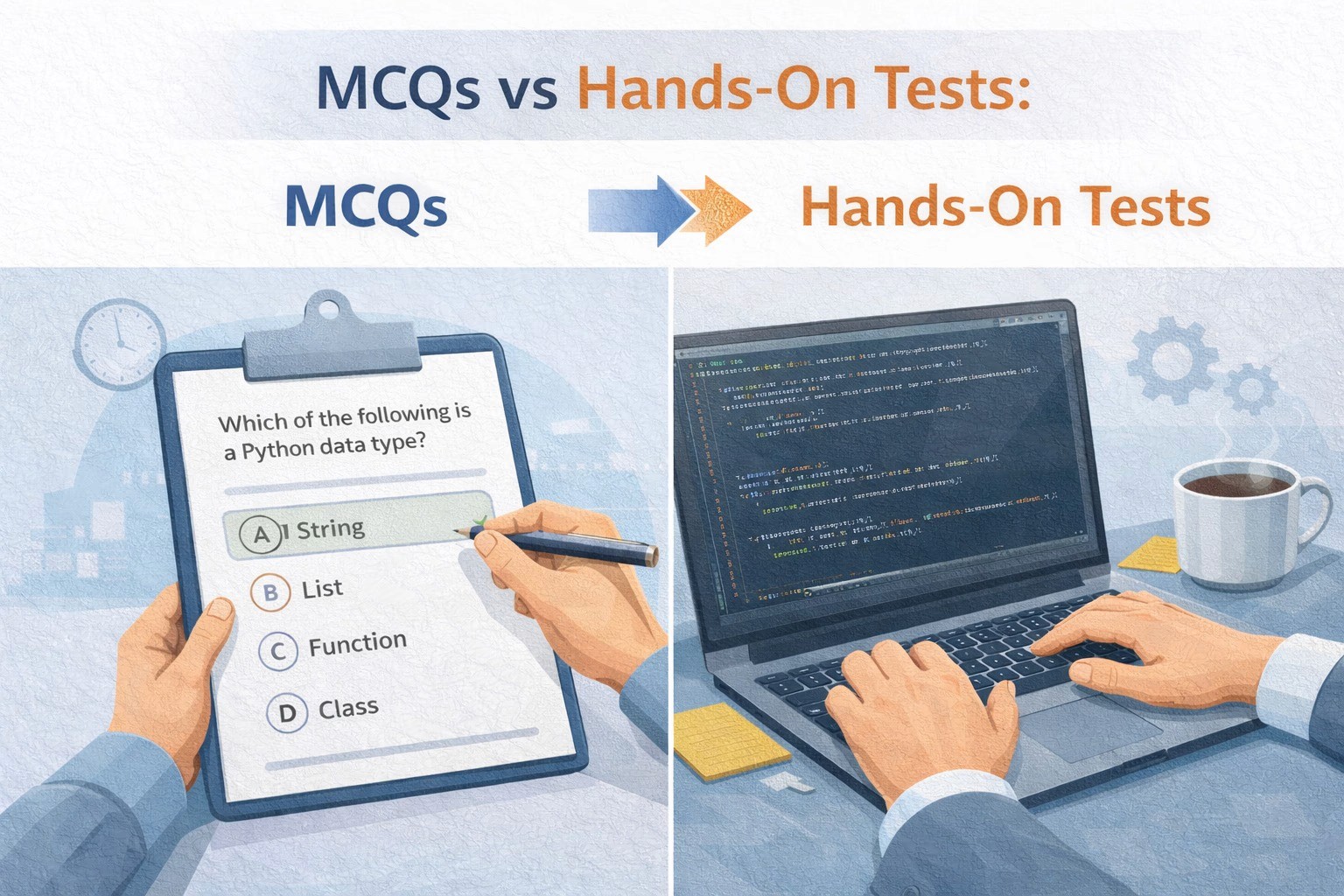
If you are a fresher, you have seen it: one company sends an aptitude + MCQ test, another asks you to code, and some give a mini project. This is not random. Companies use different tests for different reasons.
The real answer is simple: MCQs help companies screen faster. Hands-on tests help companies hire better. Most companies use a mix.
What MCQs are good for (and why they still exist)
MCQs are popular because they are fast, scalable, and easy to evaluate.

Companies use MCQs to check:
Basic programming concepts (OOP, SQL, OS, networking)
Logical reasoning and aptitude
Tool awareness (Git, testing basics, cloud basics)
Reading speed and accuracy under time pressure
In campus hiring, MCQs are often the first filter because thousands of students apply for limited roles. Platforms and employability tests commonly include aptitude + technical MCQs, and sometimes a coding section depending on the role.
Where MCQs fail: They can’t fully confirm if you can actually build, debug, or deliver a working solution in real time.
Why hands-on tests are becoming more important
Hands-on tests (coding tasks, debugging, SQL exercises, small projects, job simulations) measure real work skills.
They check things MCQs can’t:
Can you write correct code under constraints?
Can you debug and fix issues?
Can you structure your solution cleanly?
Can you read requirements and deliver output?
Can you use tools like Git and basic testing practices?
Many assessment providers explicitly offer skills + simulation style tests because simulations are closer to real job tasks than pure MCQs.
Also, industry research shows strong preference for practical coding challenges among candidates, and hiring teams are rethinking “outdated” tests.
So what do companies actually prefer in India?
In the Indian fresher job market (service + product companies), a common pattern is:
1) Round 1: MCQ + aptitude (mass screening)
Used to quickly shortlist. Especially common in campus drives.
2) Round 2: Hands-on technical test (job readiness)
Coding + SQL + debugging is typical for dev roles.
For QA, you may see test case writing + bug analysis.
For support roles, you may see scenario-based troubleshooting.
3) Final rounds: Interview + practical discussion
Even interviewers often use mini tasks: “write a query”, “explain your approach”, “fix this logic”.
Meaning: MCQs may get you shortlisted, but hands-on performance often decides the final selection.
What freshers should do (a practical plan)
Prepare for both. But give extra weight to hands-on, because that’s where job readiness shows.
Focus areas that work across roles
Coding basics + problem solving: loops, functions, arrays/strings, input/output, simple DSA
SQL: SELECT, JOINs, GROUP BY, subqueries
Debugging: read errors, fix logic, handle edge cases
Git basics: commit, branch, pull, merge (basic comfort)
One mini project: small but complete (README, screenshots, clean code)
If you want one strong advantage: build a small project and be ready to explain it clearly. Many hiring managers trust visible work more than MCQ scores.
Practical exposure is also repeatedly highlighted by industry bodies as important for employability (projects, internships, lab work) And student interest in internships remains extremely high, which aligns with why hands-on proof matters.
At VibrantMinds Technologies Pvt Ltd, fresher training is most effective when it is project-based:
You practice the same test patterns companies use (MCQ + hands-on)
You build 1–2 solid projects with guidance
You learn interview-friendly explanations, not just theory
You get placement support aligned to Indian hiring processes
Join WhatsApp Groups for Updates
Group 1: CLICK HERE> https://chat.whatsapp.com/KAXuSLpag96DcdMDsphFrO
📢 Don’t forget to forward this message to your friends and help them kick-start their careers