Full Stack Developer Roadmap for Freshers
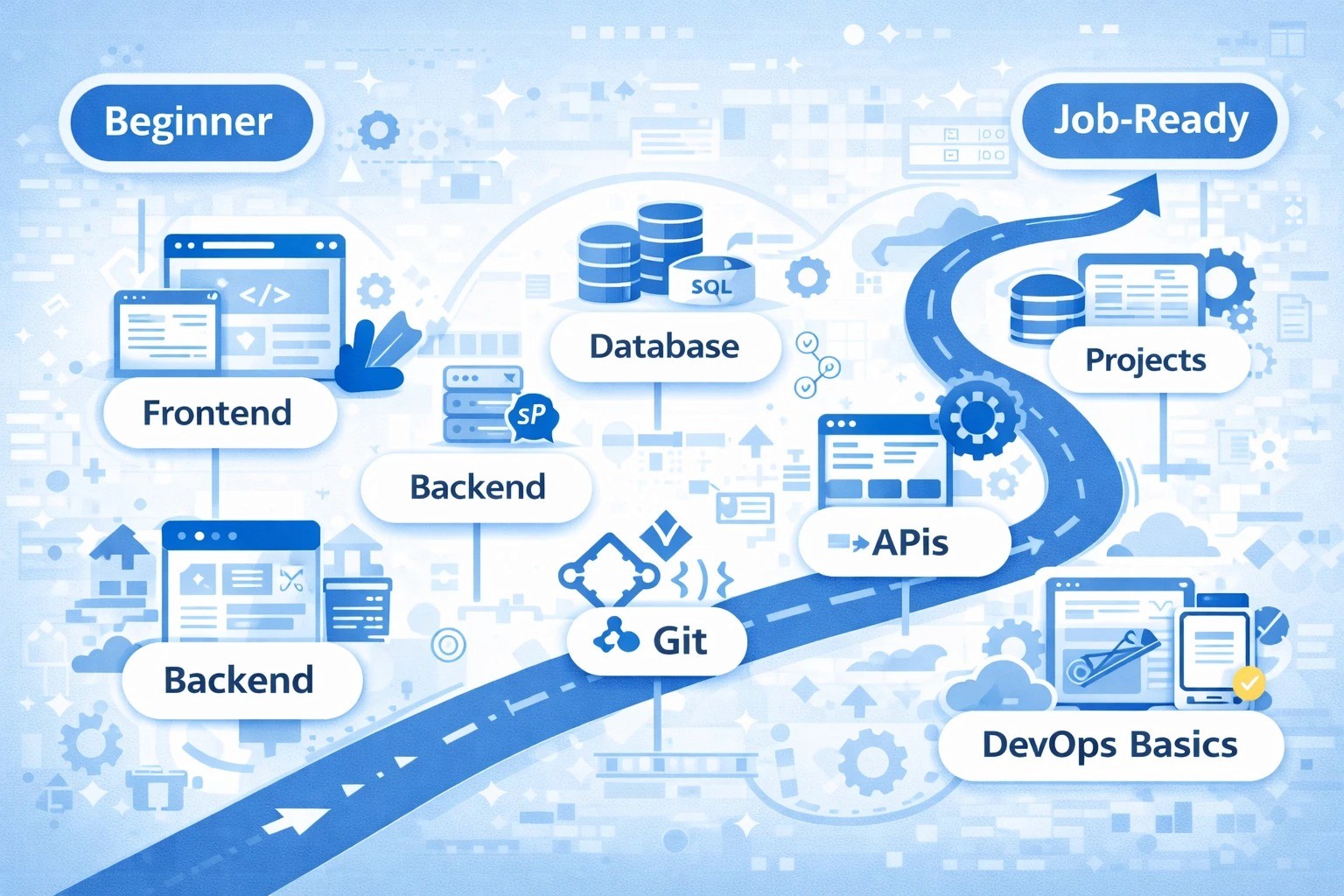
One of the most valuable and highly competitive career options for Indian IT graduates is becoming a Full Stack Developer. Recruiters are increasingly hiring candidates who are familiar with both frontend and backend development, as well as fundamental industry tools, from service-based tech companies to product startups.
You don't need to know everything in the first place itself.
Companies conduct campus placements and entry-level hiring, based on this roadmap created especially for Indian IT newcomers that takes you ahead step-by-step from beginner level to job-ready.
A Full Stack Developer: What Is It?
A full stack developer is capable of:
Build user interfaces (frontend)
Develop server-side logic (backend)
Work with databases
Use tools and workflows followed in real IT projects
Full stack developers are valued by companies. Even if they work on a specific module they do have knowledge and understanding about complete application flow.
Stage 1: Programming & Web Basics (Foundation Level)
Every fresher must start with the fundamentals.
What to Learn
Basic programming concepts (variables, loops, conditions)
One core language: Java or JavaScript
How the web works (browser, server, request, response)
Why This Matters

Indian IT recruiters do not look for advanced coding skills, but they do expect logical thinking and clean basics. Most written tests and interviews start here.
📌 Tip: Focus on clarity, not speed.
Stage 2: Frontend Development (User Interface Skills)
Frontend is what users see and interact with.
Skills to Learn
HTML – page structure
CSS – styling and layouts
JavaScript – interactivity and logic
One framework (basic level): React
Industry Reality
In addition, the typical responsibilities of Entry-Level jobs for Recent Graduates require comprehensive knowledge of how Front-End and Back-End Applications communicate with one another through the use of APIs; however, Recent Graduates will not be expected to possess Experience as a UI Designer but will be expected to be able to create Simple UI Pages that perform the required function.
Stage 3: Backend Development (Core of Full Stack)
Backend development is where most IT freshers begin their careers.
Skills to Learn
Backend language: Java
Frameworks: Spring & Spring Boot
REST API concepts
Request handling and responses
Why Companies Care
As most of the Service Organizations in India use Java-Based Backends to support their Enterprise Applications, basic experience in Using Spring Boot can greatly improve your competitiveness as a Recent Graduate.
Stage 4: Database & Data Handling
Almost every application works with data.
Skills to Learn
SQL basics (SELECT, INSERT, UPDATE, DELETE)
Database concepts (tables, keys, relationships)
MySQL or PostgreSQL
Connecting backend with database (JDBC / JPA basics)
Recruiter Expectation
Freshers are expected to write simple queries and understand how data flows through an application — not database optimization or advanced tuning.
Stage 5: Version Control & Development Tools
This stage separates classroom learners from industry-ready candidates.
Tools to Learn
Git (commit, push, pull, branch)
GitHub
IDEs: IntelliJ / VS Code
Build tools: Maven (basic)
Why This Is Important
Most Indian IT companies use Git-based workflows. Recruiters often check whether freshers have GitHub profiles or project repositories.
Stage 6: APIs, Authentication & Application Flow
Now you start thinking like a real developer.
Skills to Learn
RESTful APIs
JSON data format
Basic authentication concepts
API testing (Postman basics)
Industry Perspective
Freshers are not expected to design complex systems, but they should understand how frontend, backend, and database work together.
Stage 7: Testing, Debugging & Code Quality
Good code is not just working code.
Skills to Learn
Basic unit testing (JUnit)
Debugging using IDE tools
Logging basics
Expectations of Recruiters
Understanding testing demonstrates professional maturity. Even basic knowledge creates a positive impression during interviews.
Stage 8: Agile & DevOps Basics (Awareness Level)
You are not expected to be a DevOps engineer — awareness is enough.
Concepts to Learn
Agile methodology basics
Sprint, stand-up, deliverables
CI/CD overview
Docker and deployment concepts (intro level)
Why This Is Important
Many of the Technology Organizations in India implement the Agile Model as a way to provide their Workforce with an effective way to transition into their new Working Environment and give them a better chance of success when beginning their new Jobs.
Stage 9: Projects & Practical Experience (Most Important)
This is where many freshers either succeed or fail.
What to Build
Simple frontend website
Backend CRUD application
Full stack project (frontend + backend + database)
Upload projects to GitHub
Recruiter Reality
Projects show initiative, learning effort, and applied skills. Even small, well-explained projects are better than certificates alone.
Typical Errors Beginners Make
Learning too many technologies instead of understanding them
Thinking frontend is easier and avoiding backend
overlooking Git and tools
Projects being copied without understanding
Ignoring communication skills
You will have an advantage over many applicants by avoiding these errors.
A Simple Full Stack Skill Roadmap (Quick View)
Programming basics
Frontend fundamentals
Backend with Java & Spring Boot
Database & SQL
Git & tools
APIs & application flow
Testing & Agile awareness
Projects & interview preparation
Final Thoughts
As a fresher it is not about knowing everything but about knowing the right things in the right order to become a full stack developer. Indian IT companies value strong fundamentals, project exposure, and learning attitude far more than advanced expertise.
If you follow this roadmap consistently, you will move from beginner to job-ready with confidence.
Join WhatsApp Groups for Updates


