CI/CD Basics: What Freshers Should Learn About DevOps
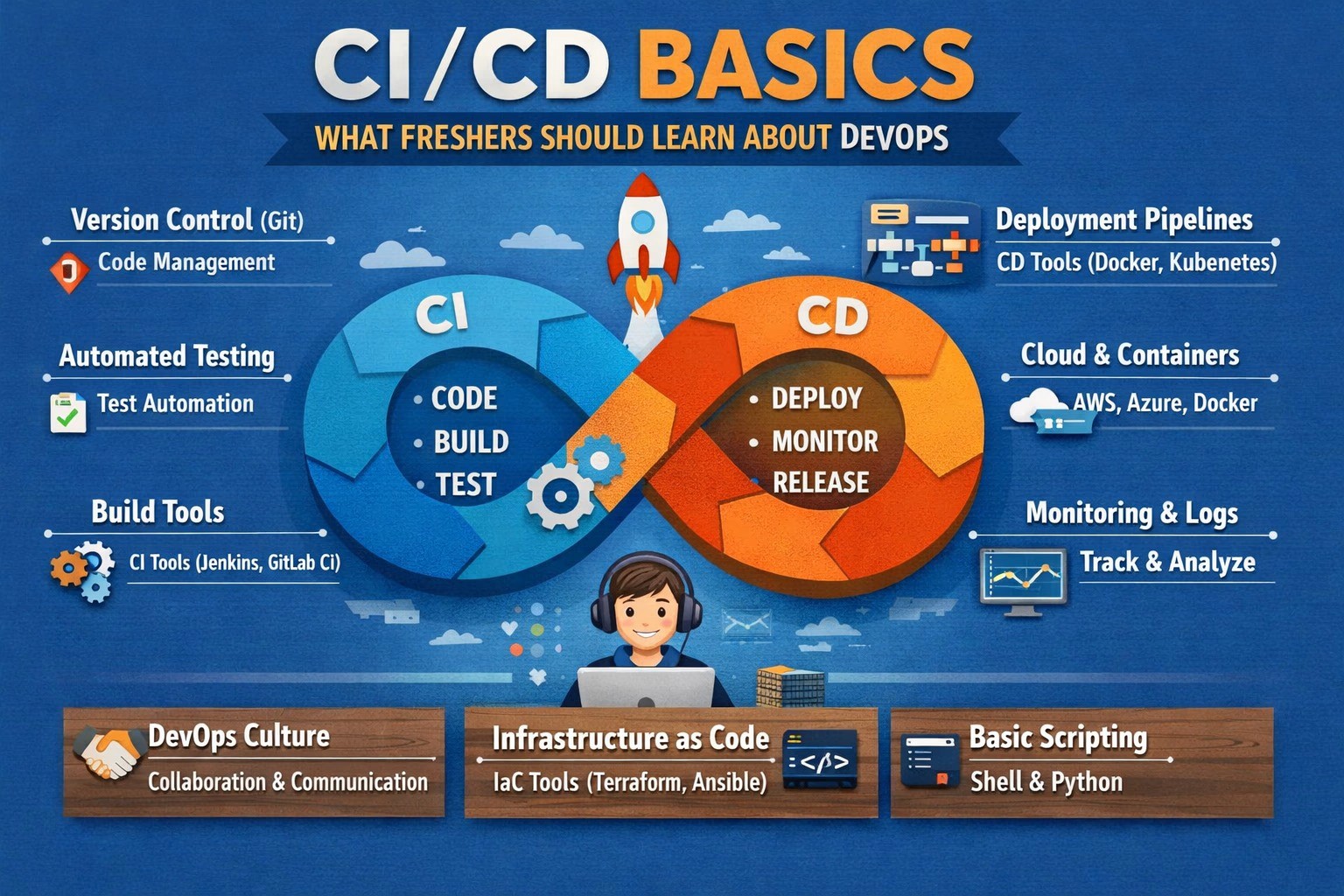
Introduction: Why CI/CD Is Important for Freshers
In today’s IT industry, writing code is not enough. Companies also care about how smoothly that code is tested, released, and maintained. This is where CI/CD plays an important role. Continuous Integration and Continuous Deployment are now standard practices in most Indian IT companies.
For freshers, CI/CD is not an advanced concept anymore. Even entry-level developers, testers, and support engineers are expected to understand the basics. Knowing CI/CD shows that you understand how real software projects work in teams.

Why CI/CD Is Important for Freshers
In the IT industry today, software development does not stop after writing code. Companies also focus on how smoothly that code is tested, released, and updated. This is where CI/CD becomes important. Continuous Integration and Continuous Deployment are now part of daily work in most Indian IT companies.
Freshers are expected to understand these basics because they will work in teams where code is shared, tested, and deployed regularly. Even if your role is not DevOps, knowing CI/CD helps you understand how real projects move forward.
What CI/CD Really Means
In simple terms, it is a process that helps teams build and release software in a faster and safer way.
Continuous Integration means developers add their code changes to a shared repository frequently. Each time code is added, automated checks run to make sure nothing breaks. This helps catch issues early instead of discovering them at the end.
Continuous Deployment or Delivery focuses on taking this tested code and making it ready for users. The aim is to reduce manual work and avoid mistakes during releases.
Why Indian IT Companies Use CI/CD
Indian IT companies work on large projects with changing requirements and strict deadlines. Manual testing and deployment slow teams down and increase errors. CI/CD helps teams deliver updates quickly while keeping quality under control.
Service-based companies use CI/CD to handle multiple client projects efficiently. Product companies depend on it to release new features regularly without affecting existing users. This is why CI/CD knowledge is now expected even from fresh graduates.
How a CI/CD Pipeline Works
A CI/CD pipeline is a set of steps that code goes through after it is pushed to a repository. These steps run automatically and follow the same order every time.
A simple pipeline for a web application usually includes:
Code is pushed to version control
The application is built automatically
Tests are run to check functionality
Code quality checks are performed
The application is prepared for deployment
The build is deployed to a server
Automation is the key idea here. Once set up, the pipeline runs without manual effort.
Understanding Continuous Integration
Continuous Integration focuses on frequent and small code updates. Instead of working for weeks and merging everything at once, developers integrate changes regularly. This makes it easier to find bugs and reduces conflicts between team members.
For freshers, CI encourages good habits such as writing clean code, running tests, and collaborating with others. Interviewers often ask about CI to see if candidates understand teamwork in software development.
Continuous Deployment and Delivery Explained
Continuous Delivery means the software is always in a ready-to-release state, but the final release may still need approval. Continuous Deployment goes one step further by automatically releasing every successful update to users.
Not every company uses full automation for production releases, especially in sensitive industries. Still, understanding the difference helps freshers explain modern development practices clearly.
CI/CD Tools: What Freshers Should Know
At the beginner level, concepts are more important than tools. However, freshers should know that CI/CD tools help automate building, testing, and deploying applications. Some tools run on servers, while others are cloud-based and work directly with code repositories.
Companies do not expect freshers to configure complex pipelines. Basic understanding of how tools support automation is enough.
Who Uses CI/CD in IT Teams
CI/CD is useful across many roles, not just DevOps.
Developers use it to test and validate code changes
QA teams rely on it to run automated tests
Cloud and DevOps teams manage deployments
Support teams monitor releases and fixes
This is why CI/CD basics are helpful for all IT freshers.
Common Confusions Freshers Have
Many freshers think CI/CD is only about tools or scripting. In reality, it is more about improving the development process. Automation supports the process, but the goal is faster feedback and reliable delivery. Another common belief is that CI/CD replaces testing. In fact, testing is a core part of CI/CD.
Learning and Skill Support
Freshers often learn CI/CD through guided learning and practical exposure. Skill development organizations such as VibrantMinds Technologies Pvt Ltd help beginners understand DevOps and CI/CD concepts in a structured and industry-friendly way. This support helps freshers move smoothly from theory to real-world projects.
Final Words for Fresh Graduates
CI/CD is a basic but powerful concept in modern DevOps. You do not need deep expertise at the start, but you must understand how it works and why companies use it. For Indian IT freshers, clear CI/CD knowledge shows readiness for real projects and team-based work.
Join WhatsApp Groups for Updates
Group 1: CLICK HERE> https://chat.whatsapp.com/KAXuSLpag96DcdMDsphFrO
📢 Don’t forget to forward this message to your friends and help them kick-start their careers