Why Campus Placements Are Declining for IT Students
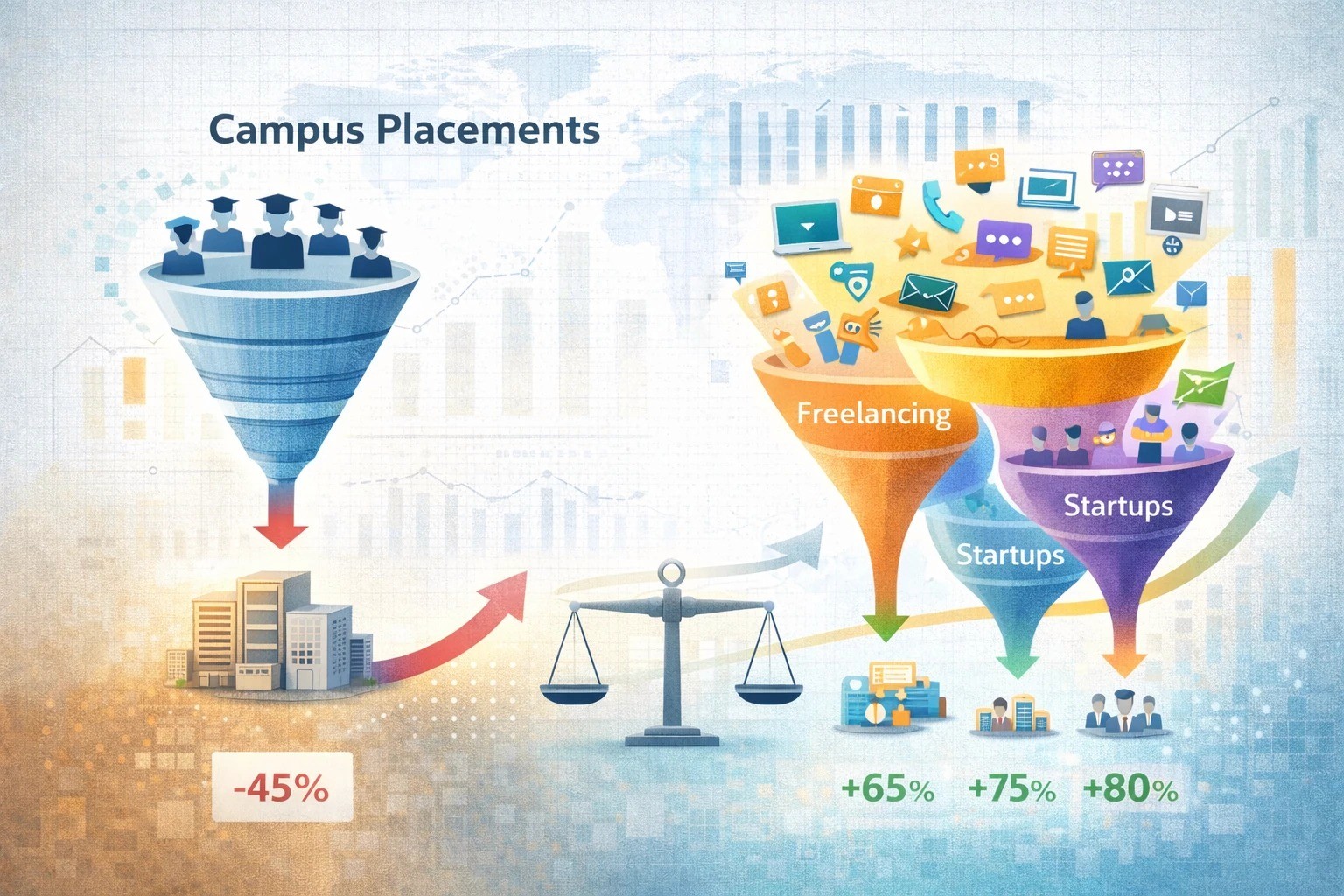
For decades, campus placements were seen as the safest and most straightforward entry into the IT industry for engineering graduates in India. Large service companies conducted mass recruitment drives, offering freshers a clear path from college to corporate life.
However, in recent years, many students and colleges have noticed a clear change: fewer companies visiting campuses, fewer offers, and stricter selection processes. This has led to anxiety among freshers and confusion about what is really happening in the IT job market.
Campus placements are not disappearing entirely—but they are changing. Understanding why this shift is happening helps students prepare better instead of relying on outdated expectations.
Campus Placements: What Has Been Changed?
Earlier, campus hiring focused heavily on:
Bulk recruitment
Basic eligibility filters
Post-joining training
Today, companies are more selective. Hiring has moved toward:
Skill readiness
Role-specific evaluation
Smaller, targeted intakes
This shift affects both service companies and product companies, though in different ways.
Reason 1: Skill Mismatch Between Colleges and Industry
One of the most widely acknowledged reasons for declining campus placements is the gap between academic curriculum and industry requirements.
What Colleges Focus On
Theory-heavy subjects
Exam-oriented learning
Limited exposure to real-world systems
What Companies Need
Practical problem-solving ability
Application of fundamentals
Understanding of how systems work in real environments
Many graduates have degrees but lack job-ready skills, which makes companies cautious about mass hiring.
Reason 2: Shift Away from Mass Hiring Models
Large IT service companies historically hired thousands of freshers every year and trained them after joining. This model is changing due to:
Cost optimization
Faster project timelines
Client demand for ready-to-deploy talent
Instead of training large batches, companies now prefer:
Smaller intakes
Candidates with clearer skill alignment
Faster onboarding capability
This naturally reduces the number of campus offers.
Reason 3: Increased Automation and Tool-Based Workflows
Automation has significantly changed entry-level IT roles.
Tasks that earlier required:
Manual testing
Repetitive coding
Basic support work
are now handled using:
Automation frameworks
Low-code platforms
AI-assisted tools
As a result, fewer entry-level roles are available, and the remaining ones demand higher quality input from freshers.
Reason 4: Economic Cycles and Global Market Uncertainty
IT hiring in India is closely tied to global demand. Factors such as:
Global economic slowdowns
Reduced technology spending by clients
Uncertainty in international markets
directly affect hiring plans.

When demand slows, companies:
Delay hiring
Reduce campus visits
Focus on critical roles only
This does not reflect a permanent decline in IT jobs, but rather cyclical hiring behavior.
Reason 5: Changing Hiring Methods
Campus placement is no longer the primary hiring channel for many companies.
Recruitment now happens through:
Online coding platforms
Skill-based assessments
Internships and apprenticeships
Off-campus drives and referrals
Students who rely only on campus drives often miss these alternative opportunities.
Reason 6: Rising Expectations from Freshers
Today’s freshers compete in a much more crowded talent pool.
Companies expect:
Better fundamentals
Clearer communication
Some level of hands-on exposure
A degree alone is no longer enough to stand out. This raises the bar for campus selection.
Service Companies vs Product Companies: Placement Reality
Service Companies
Still hire freshers, but in smaller numbers
Focus on adaptability and communication
Expect faster learning and project readiness
Product Companies
Rarely rely on mass campus hiring
Emphasize problem-solving and fundamentals
Prefer internships, contests, or direct applications
Both have reduced dependency on traditional placement models.
What This Means for IT Students (Realistically)
The decline in campus placements does not mean:
IT careers are over
Engineering degrees are useless
Jobs are unavailable
It means:
The hiring process has become more selective
Preparation needs to be more focused
Students must take more responsibility for skill development
Campus placement is now one of many entry points, not the only one.
Common Mistakes Freshers Make
Depending entirely on college placements
Learning many tools without mastering basics
Ignoring communication and explanation skills
Treating preparation as last-minute activity
These mistakes reduce employability even when opportunities exist.
How Freshers Can Adapt to the New Reality
Freshers who perform well today usually:
Focus on fundamentals and clarity
Build a few strong, explainable projects
Practice interviews and problem-solving
Explore off-campus and online hiring channels
This approach works regardless of placement outcomes.
The Role of Colleges Is Also Evolving
Many institutions are now:
Updating curricula
Introducing industry partnerships
Encouraging internships and live projects
However, these changes take time, and students must proactively supplement their learning.
Final Thoughts
Campus placements in IT are not declining because freshers lack potential. They are changing because the industry itself is changing.
The shift is from quantity to quality, from degree-based hiring to skill-based evaluation, and from mass recruitment to targeted selection.
Freshers who understand this reality early—and prepare accordingly—are far better positioned to succeed, whether through campus placements or alternative hiring routes.
Adapting to change, rather than fearing it, is the key to building a strong and sustainable IT career
Join WhatsApp Groups for Job Updates
Group 1: CLICK HERE> https://chat.whatsapp.com/KAXuSLpag96DcdMDsphFrO
📢 Don’t forget to forward this message to your friends and help them kick-start their careers


