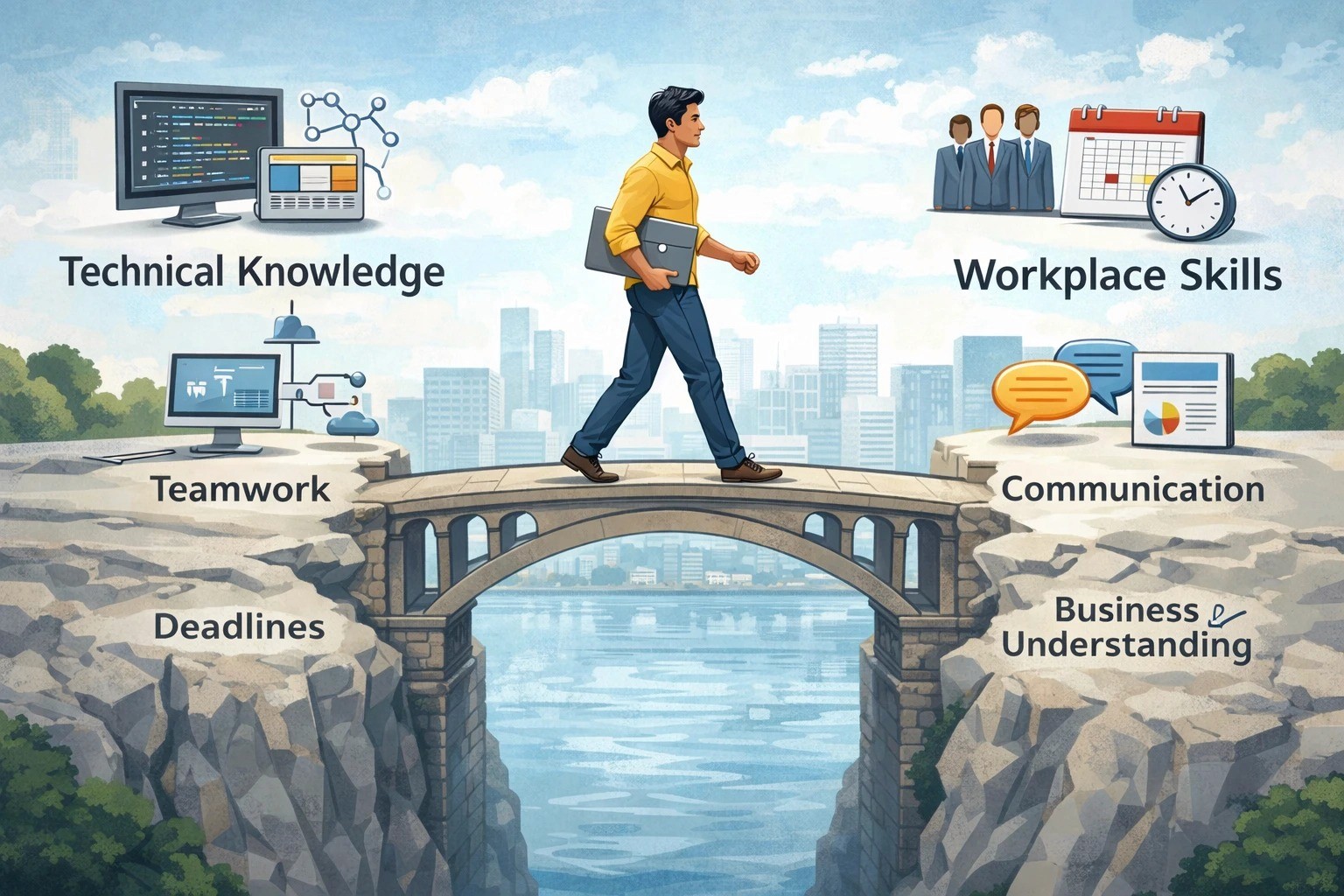
Bridging the Gap Between Technical Knowledge and Workplace Expectations
For many engineering graduates in India, entering the IT industry is both exciting and confusing. After years of studying programming languages, databases, and theory-heavy subjects, freshers often assume they are ready for the workplace. However, the reality inside IT companies—both service and product-based—is very different from what most colleges prepare students for.
This gap between what freshers know and what the workplace expects is one of the biggest reasons new graduates struggle during interviews and in their first few months on the job. Understanding this gap clearly is the first step toward closing it.
Understanding the Gap: Knowledge vs Readiness
Most engineering colleges focus on:
Syllabus completion
Exam-oriented learning
Theory-heavy subjects
Limited real-world exposure
On the other hand, IT companies evaluate freshers on:
Ability to apply fundamentals
Clarity of thinking
Problem-solving approach
Communication and collaboration
Learning speed and attitude
This difference does not indicate that freshers are incapable. It highlights that academic learning and job readiness are not the same.
What the Workplace Actually Expects from Freshers
Despite what many freshers think, companies do not expect them to know everything. Instead, they look for the following:

1. Strong Fundamentals (Not Advanced Topics)
Employers value:
Clear understanding of programming basics
Logical thinking
Core concepts of databases, operating systems, and networking
They do not expect deep expertise in every technology.
2. Ability to Learn on the Job
In service companies, projects change frequently. In product companies, tools and frameworks evolve fast. Freshers are evaluated on:
How quickly they learn
How they respond to feedback
How they adapt to new tools
Learning ability matters more than current knowledge.
3. Problem-Solving Mindset
Companies look for:
How you break down a problem
How you think through a solution
How you handle uncertainty
Even if the final answer is not perfect, your approach matters.
4. Clear Communication
You don’t need perfect English. You do need:
Clear explanations
Structured thinking
Confidence to ask questions
In real projects, unclear communication causes more issues than lack of coding skill.
Why Freshers Often Struggle Despite Technical Knowledge
1. Over-Reliance on Theory
Many students memorize definitions without understanding how concepts are used in real systems. Interviewers quickly detect this through follow-up questions.
2. Limited Hands-On Practice
Labs and mini-projects often lack depth. Freshers struggle to explain:
Why a solution was designed a certain way
Trade-offs involved
Real constraints
3. No Exposure to Team-Based Work
In the workplace:
Code is reviewed
Work is collaborative
Deadlines matter
Freshers used to individual assignments often find this challenging.
4. Mismatch Between Resume and Reality
Listing too many tools without real experience creates trust issues during interviews.
Service Companies vs Product Companies: Expectations Compared
Service Companies
Focus on project readiness
Expect quick learning and adaptability
Value clear communication with clients and teams
Prefer candidates who can follow processes and documentation
Product Companies
Focus on problem-solving depth
Expect stronger fundamentals
Value structured thinking and clean code
Look for clarity over speed
However, both expect honesty, basics, and learning ability.
A Simple approach to Bridge the Gap
Step 1: Strengthen Fundamentals
Instead of learning many tools, focus on:
One programming language deeply
Core data structures and logic
Basics of databases and system concepts
Depth beats breadth for freshers.
Step 2: Convert Knowledge into Application
Ask yourself:
Where is this concept used in real systems?
What problem does it solve?
What happens if it fails?
Use small, practical examples when explaining concepts.
Step 3: Build Fewer but Stronger Projects
A good fresher project should clearly show:
Problem statement
Solution approach
Tools used
Challenges faced
What you learned
Two strong projects are better than six weak ones.
Step 4: Practice Explaining, Not Just Doing
Many freshers can code but cannot explain their code. Practice:
Explaining logic step-by-step
Answering “why” questions
Talking about trade-offs
This directly improves interview performance.
Step 5: Learn Workplace Basics Early
Understand basics such as:
Version control concepts
Code reviews
Debugging practices
Working with timelines
This reduces the initial shock when you join a company.
The Role of Attitude and Professional Behavior
Technical skills get you shortlisted. Professional behavior helps you grow.
Companies value freshers who:
Take ownership
Accept feedback positively
Ask questions without fear
Show consistency
These qualities are often discussed during performance reviews, even at entry level.
Certifications vs Skills: A Reality Check
Certifications can help signal interest, but they do not replace:
Hands-on practice
Conceptual clarity
Problem-solving ability
Employers prefer candidates who can explain what they learned, not just show certificates.
Final Thoughts
The gap between technical knowledge and workplace expectations is real—but it is not permanent. Thousands of successful IT professionals started their careers feeling underprepared.
What makes the difference is not intelligence, but direction.
Freshers who focus on fundamentals, practical application, communication, and learning mindset bridge this gap faster and perform better in interviews and on the job.
With the right preparation approach, engineering graduates can transition smoothly from classrooms to real IT workplaces—and build strong, long-term careers
Join WhatsApp Groups for Updates