Your First 90 Days at an IT Job (2026)

A Week-by-Week Survival Guide for Freshers — What to Expect, What to Avoid, and How to Actually Succeed
Getting placed is the finish line for a job search — but it's the starting line for the part that actually shapes your career. The first 90 days at your first IT job set the tone for how your manager sees you, how fast you're trusted with real work, and often how your first performance review goes. This guide walks through what to genuinely expect week by week, the common emotional dip almost nobody warns freshers about, and the specific habits that separate new hires who thrive from ones who quietly struggle.
The First 90 Days Confidence Curve
Almost every new hire — not just freshers — goes through a predictable emotional pattern in their first three months, and knowing it's coming makes it far easier to handle:
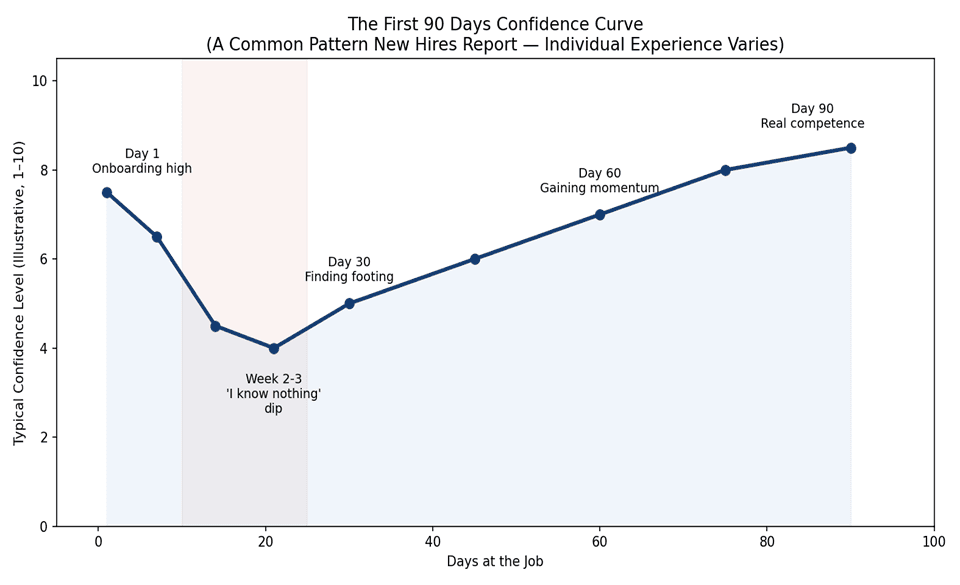
Day one usually feels good — orientation, introductions, a sense of achievement at finally starting. Then, somewhere around week two or three, a genuine dip sets in: you've seen enough of the codebase and the team to realize how much you don't know, and the gap between "I finished a placement course" and "I can actually contribute here" feels much wider than expected. This is normal, not a sign you're failing. Confidence typically climbs steadily from there as real tasks, feedback, and small wins accumulate.
Where Your Time and Focus Actually Shift
Beyond the emotional pattern, there's a fairly consistent structure to how new hires' actual day-to-day work evolves over 90 days:
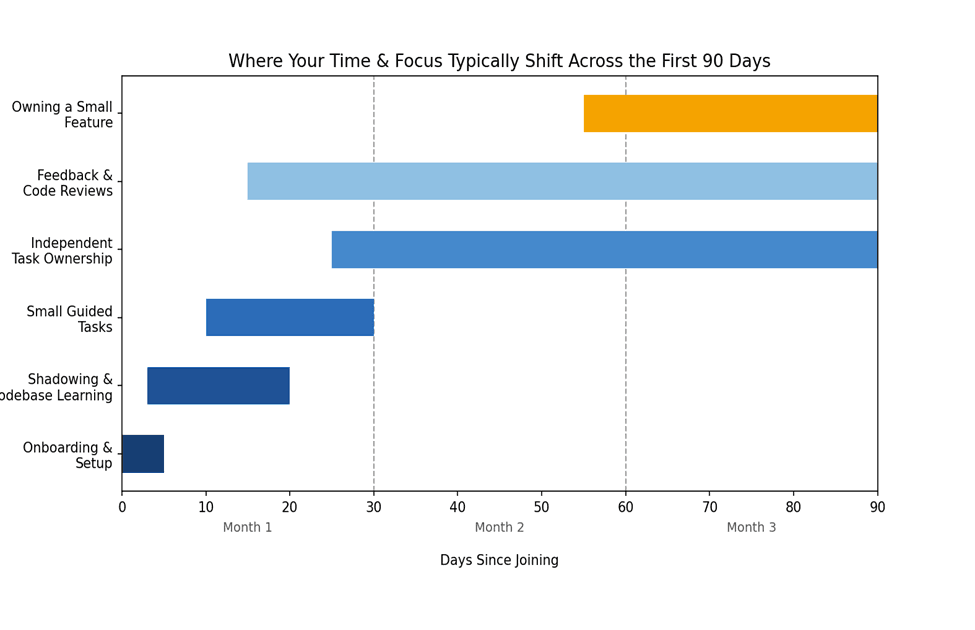
• Days 1–5: Onboarding and setup — laptop, access, tools, HR formalities, and initial team introductions
• Days 3–20: Shadowing and codebase learning — reading existing code, attending meetings mostly as an observer, understanding how the team actually works day to day
• Days 10–30: Small guided tasks — bug fixes, minor features, usually with a mentor or buddy reviewing closely
• From day 25 onward: Independent task ownership grows steadily, alongside regular feedback and code review cycles
• From around day 55: Many new hires start owning a small feature or module end-to-end — a meaningful marker of real integration into the team
Week-by-Week: What to Actually Expect
Period | What Typically Happens |
Week 1 | Onboarding, laptop/access setup, HR paperwork, team introductions, and usually a lighter workload than expected |
Weeks 2–3 | The steepest learning curve — codebase exploration, dev environment setup, and often the confidence dip described above |
Weeks 4–5 | First small, guided tasks; this is where consistent questions and documentation habits start paying off |
Month 2 | Growing task independence, first real code reviews, and typically a first informal check-in with your manager |
Month 3 | Increased ownership, possibly a small feature end-to-end, and often a formal 90-day or probation-period review |
Common Mistakes New Hires Make in the First 90 Days
• Staying silent when stuck instead of asking — most managers would far rather answer a question early than discover a blocked task three days later
• Comparing your pace to a more experienced teammate's, rather than to your own progress from week to week
• Not documenting what you learn — rebuilding the same understanding from scratch when a similar issue resurfaces weeks later
• Avoiding feedback conversations, or treating constructive feedback as a sign of failure rather than normal onboarding
• Going quiet about being overwhelmed instead of communicating workload concerns early, before they become a pattern
• Underestimating the value of simply being reliable — showing up on time, meeting small deadlines, and following through consistently matters more early on than any single technical achievement
What Actually Helps You Succeed
• Ask specific, well-framed questions — "I tried X and got Y error, what am I missing?" lands far better than a vague "I'm stuck"
• Keep a running personal document of what you learn — commands, processes, codebase quirks — it compounds into real value within weeks
• Over-communicate status on tasks, especially when blocked — silence reads as either stuck or disengaged, neither of which is the impression you want
• Build relationships beyond your immediate team — a coffee chat with someone in a different team often pays off later in ways you can't predict
• Treat your first code reviews as calibration, not judgment — they're telling you the team's actual standards, which you couldn't have learned any other way
• Track your own wins, even small ones — it's easy to forget how much you've actually absorbed by day 60 compared to day 1
What Your Manager Is Actually Evaluating at the 90-Day Mark
Most formal or informal 90-day reviews weigh a fairly consistent set of factors — and technical brilliance alone is rarely at the top:
• Reliability and follow-through — did you consistently deliver on what you committed to, even small things
• Communication — do you flag blockers early, or does your manager have to chase updates
• Coachability — how you respond to feedback and correction, not whether you needed any
• Trajectory — how much you've grown from week 1 to week 12, which matters more than your absolute skill level on day one
• Team fit — whether you're someone colleagues want to collaborate with, not just someone who can code
This is genuinely good news for freshers: none of these factors require years of experience to demonstrate. They're about habits, not tenure.
If You're Approaching Your First 90 Days Soon
A structured, project-based training program can meaningfully shape how ready you feel walking in — not because it teaches company-specific processes, which no course can, but because daily hands-on practice and mock interviews build exactly the habit of working through unfamiliar problems that the first 90 days demands constantly. VibrantMinds Technologies, whose Full Stack Java program is built around daily coding practice and real tools rather than theory-only sessions, is one example of training designed with this transition in mind — the goal isn't just passing an interview, but being genuinely ready for what comes after it.
VibrantMinds Full Stack Java Course: https://vibrantminds.in/
Frequently Asked Questions
Q: Is it normal to feel completely lost in the first few weeks? Yes — this is one of the most consistently reported experiences among new hires, freshers and experienced professionals alike. It reflects the genuine gap between training and a live, unfamiliar codebase, not a personal failing.
Q: How soon should I start asking questions? Immediately, and often. Most teams expect a high volume of questions in the first few weeks — it's a far better signal than staying quiet and falling behind.
Q: What if I'm still struggling by day 60? Talk to your manager directly and specifically about what's difficult — most 90-day timelines have real flexibility built in, and managers generally respond far better to early, honest conversations than to silence followed by a missed deadline.
Q: Does everyone go through the confidence dip described above? Most people report something like it, though intensity and timing vary. Knowing it's a common, temporary pattern — not a sign you made the wrong career choice — tends to make it easier to get through.
Q: What's the single most useful habit for a fresher's first 90 days? Consistent, proactive communication — about progress, blockers, and questions — tends to matter more to how you're perceived than any individual technical task in this period.
Bottom Line
The first 90 days are less about proving you already know everything and more about demonstrating how you learn, communicate, and follow through when you don't. The confidence dip around week two or three is normal and temporary. Ask questions early, document what you learn, communicate proactively, and judge your own progress against where you started — not against a more experienced colleague. By day 90, most freshers who follow this pattern look back and barely recognize how uncertain they felt on day one.


