Where Is the Best Java Full Stack Developer Course With Placement in 2026?

Searching for the best Java Full Stack Developer course with placement can be confusing, especially if you are a fresher looking for your first IT job.
You may find many courses promising placement assistance, job opportunities, practical training, or career support. But the real question is not simply “Which Java course is best?”
The better question is:
Does the course actually teach the technical skills, practical development, interview skills, and job-readiness needed to become a Java Full Stack Developer?
For students in Pune and across India, VibrantMinds Technologies offers a 6-month Full Stack Java program designed around technical training, coding practice, DSA, projects, aptitude, communication, interview preparation, and placement support. Its current course page lists training in Core Java, Advanced Java, Java 8+, Spring Boot, REST APIs, SQL, HTML, CSS, JavaScript and related development technologies.
So, if you are looking for a Java Full Stack Developer course with placement in Pune, VibrantMinds is one option worth evaluating based on its curriculum, practical training model, and career-support structure.
Why Is Java Still a Strong Choice for Full Stack Development?
Java continues to be an important technology for enterprise software development. Oracle describes Java as an enterprise-grade platform used for modern application development, with current Java releases including Java 26 and long-term-support versions such as Java 25 and Java 21.
For a fresher, however, learning only Core Java is not enough.
A job-ready Java Full Stack Developer should understand how the different parts of an application work together:
Frontend → Backend → Database → APIs → Application Logic → Deployment
That is why a good Java Full Stack Developer course should go beyond syntax and theoretical concepts.
You should learn how to:
Write Java programs
Understand object-oriented programming
Solve programming and DSA problems
Work with SQL and databases
Build backend applications
Develop REST APIs
Use Spring and Spring Boot
Create frontend interfaces
Connect frontend and backend
Build real projects
Use development tools
Explain your projects during interviews
Spring Boot is particularly important in modern Java backend development because it helps developers build applications while reducing infrastructure-related configuration. The official Spring documentation provides hands-on guides for creating Spring Boot web applications and REST-based applications.
What Should You Look for in the Best Java Full Stack Course With Placement?
The word “placement” should never be the only reason you select a course.
Before joining any Java Full Stack training institute, examine what happens before the placement stage.
A strong program should ideally cover five areas:
1. Strong Java Fundamentals
Your foundation should include Core Java, OOP concepts, classes and objects, inheritance, abstraction, encapsulation, polymorphism, exception handling, collections, strings, arrays, multithreading and other essential concepts.
Without strong fundamentals, learning Spring Boot or advanced frameworks becomes much harder.
2. Data Structures and Algorithms
DSA is important because many technical interviews and coding assessments evaluate problem-solving ability.
A Java Full Stack course for freshers should therefore include topics such as:
Arrays
Linked Lists
Stacks
Queues
Searching
Sorting
Recursion
Problem-solving
Basic algorithmic thinking
The objective is not to memorize hundreds of programs.
The objective is to learn how to approach an unfamiliar programming problem.
3. Backend Development With Spring Boot
A serious Java Full Stack program should teach backend development rather than stopping at Core Java.
This should include technologies such as:
Java → Spring → Spring Boot → REST APIs → Database Integration
Students should understand how a backend receives requests, processes business logic, communicates with databases and returns responses.
4. Frontend Development
Full Stack means working across both frontend and backend.
A beginner-oriented Java Full Stack course should therefore introduce technologies such as:
HTML
CSS
JavaScript
React.js or another relevant frontend technology
The goal is to understand how the user interface communicates with the backend.
5. Practical Projects
This is one of the most important factors.
A fresher who says:
“I completed a Java course.”
has less evidence of practical ability than someone who can say:
“I built a full-stack application, designed its database, created REST APIs, connected the frontend and backend, implemented authentication, and can explain my technical decisions.”
Your projects become evidence of what you can actually do.
Why VibrantMinds Is Worth Considering for Java Full Stack Training in Pune
If your search is specifically for a Java Full Stack Developer course with placement in Pune, VibrantMinds Technologies has structured its Full Stack Java program around both technical learning and job preparation.
Its current course information describes a 6-month Full Stack Java program in Pune covering Core Java, Advanced Java, Java 8+, DSA, Spring Boot, REST APIs, SQL, HTML, CSS and JavaScript. The program also includes practical coding, aptitude preparation, spoken English, soft-skills development, group discussions, resume guidance, mock interviews and placement assistance.
The program is designed for freshers and graduates targeting roles such as:
Java Developer
Full Stack Developer
Backend Developer
Software Engineer
Graduate Engineer Trainee
The course page also describes structured practical sessions involving Java programming, DSA, SQL, frontend exercises, backend development, assignments and revision.
This combination is important because getting a software job requires more than completing technical lectures.
You need to learn → practice → build → explain → interview.
What Does the VibrantMinds Java Full Stack Course Cover?
The curriculum is designed to take students from programming fundamentals toward full-stack application development.
Core Java
Students work with important Java concepts including:
Variables and data types
Operators
Conditional statements
Loops
Classes and objects
OOP
Inheritance
Abstraction
Encapsulation
Polymorphism
Strings
Arrays
Exception handling
Multithreading
Collections
Data Structures and Algorithms
The program includes DSA topics such as arrays, linked lists, stacks, queues, searching, sorting and recursion, with an emphasis on problem-solving and coding practice.
Java 8+
Students are introduced to modern Java concepts including:
Functional interfaces
Lambda expressions
Method references
Stream API
Filtering
Mapping
Sorting
Aggregation
Reduction
Backend Development
The curriculum progresses toward technologies including:
Spring
Spring Boot
REST APIs
Spring MVC
Hibernate
Database integration
Database and SQL
SQL is an essential part of full-stack development because applications need to store, retrieve and manipulate data.
Students should become comfortable with:
SQL queries
Joins
Subqueries
Database design
CRUD operations
Data relationships
Query-based problem solving
Frontend Development
The program also covers:
HTML
CSS
JavaScript
React.js and related development technologies
The current VibrantMinds course page lists additional technologies and tools including Git & GitHub, Postman and Docker.
Placement Support: What Should a Fresher Expect?
One important distinction is between placement assistance and a guaranteed job.
No genuine training program can completely control whether a company selects a candidate. Hiring depends on factors such as technical performance, communication, eligibility, interview performance, academic criteria and employer requirements.
VibrantMinds currently describes its program as providing 100% placement assistance and unlimited placement calls, while also explicitly noting that placement outcomes depend on eligibility, individual performance, academic criteria, company requirements and market conditions.
That distinction matters.
A good Java course with placement assistance should help you become capable of participating in:
Aptitude Test → Coding Assessment → Technical Interview → Group Discussion → HR Interview
rather than simply promising that a job will appear after completing the course.
What Makes a Java Full Stack Course Job-Oriented?
A job-oriented course should simulate the journey a fresher actually experiences while applying for software jobs.
For example:
Stage 1: Learn
Build your Java, SQL, frontend and backend fundamentals.
Stage 2: Practice
Solve coding problems and write SQL queries regularly.
Stage 3: Build
Develop projects that demonstrate your skills.
Stage 4: Prepare
Work on aptitude, communication, resume and interview preparation.
Stage 5: Apply
Participate in relevant recruitment opportunities.
Stage 6: Improve
Use interview feedback to strengthen weak areas and continue applying.
This approach is much more useful than collecting certificates without developing practical ability.
Who Should Join a Java Full Stack Developer Course?
A structured Java Full Stack course can be useful for:
Freshers after graduation:
Students who have completed B.E., B.Tech, BCA, MCA, BSc, MSc or related programs and want to enter software development.
Students with basic programming knowledge:
Candidates who know programming fundamentals but struggle to build complete applications.
Career starters:
People who want to build a career as a Java Developer, Backend Developer or Full Stack Developer.
Candidates preparing for IT interviews:
Students who understand Java but need structured DSA, SQL, coding and interview preparation.
The most important requirement is not having perfect knowledge before joining.
It is being willing to practice consistently.
Why Learning Java Alone Is Not Enough
One common mistake among freshers is spending months learning Java syntax without learning how Java is used to develop applications.
For example, knowing this:
class Student { }
is not the same as knowing how to build a student-management application.
A job-ready developer needs to understand the complete development process:
Requirement → Design → Code → Database → API → Testing → Debugging → Deployment
This is where full-stack training can provide an advantage over learning isolated programming concepts.
How Long Does It Take to Become Job-Ready in Java Full Stack?
There is no fixed number of months that guarantees employment.
Your timeline depends on your starting knowledge, daily practice, project work and interview preparation.
A structured six-month program can provide a clear learning framework, but students still need consistent individual practice.
A realistic progression can look like:
Months 1–2: Java fundamentals + OOP + SQL + programming practice
Months 3–4: DSA + Spring + Spring Boot + REST APIs + database integration
Months 5–6: Frontend + full-stack projects + interview preparation + aptitude + communication + job applications
The important point is that the end of the course should not be the end of learning.
It should be the beginning of your professional development journey.
How to Choose the Best Java Full Stack Course in Pune
Before paying for any Java Full Stack Developer course with placement, ask these questions:
Does the curriculum include Core Java and advanced Java concepts?
Is DSA included?
Will I learn SQL and database concepts?
Does the program teach Spring Boot and REST APIs?
Will I learn frontend technologies?
Will I build practical projects?
Is there regular coding practice?
Does the program include mock interviews?
Is aptitude preparation included?
Will someone help me improve my resume and communication skills?
How exactly does placement assistance work?
Are placement claims clearly explained with eligibility conditions?
These questions can help you distinguish between a course that simply teaches technologies and one designed around job readiness.
Why Choose VibrantMinds Technologies for Java Full Stack Training?
VibrantMinds Technologies focuses on combining technical training, practical learning and career preparation.
Its current program brings together:
Core Java + Advanced Java + Java 8+ + DSA + SQL + Spring + Spring Boot + REST APIs + Frontend Development + Projects + Aptitude + Communication + Soft Skills + Interview Preparation + Placement Assistance
The institute also states that students can access classroom or online training and structured practical sessions.
Its broader training and placement offering also highlights technical preparation, aptitude training, mock interviews, resume and interview preparation, and job opportunities and placement support.
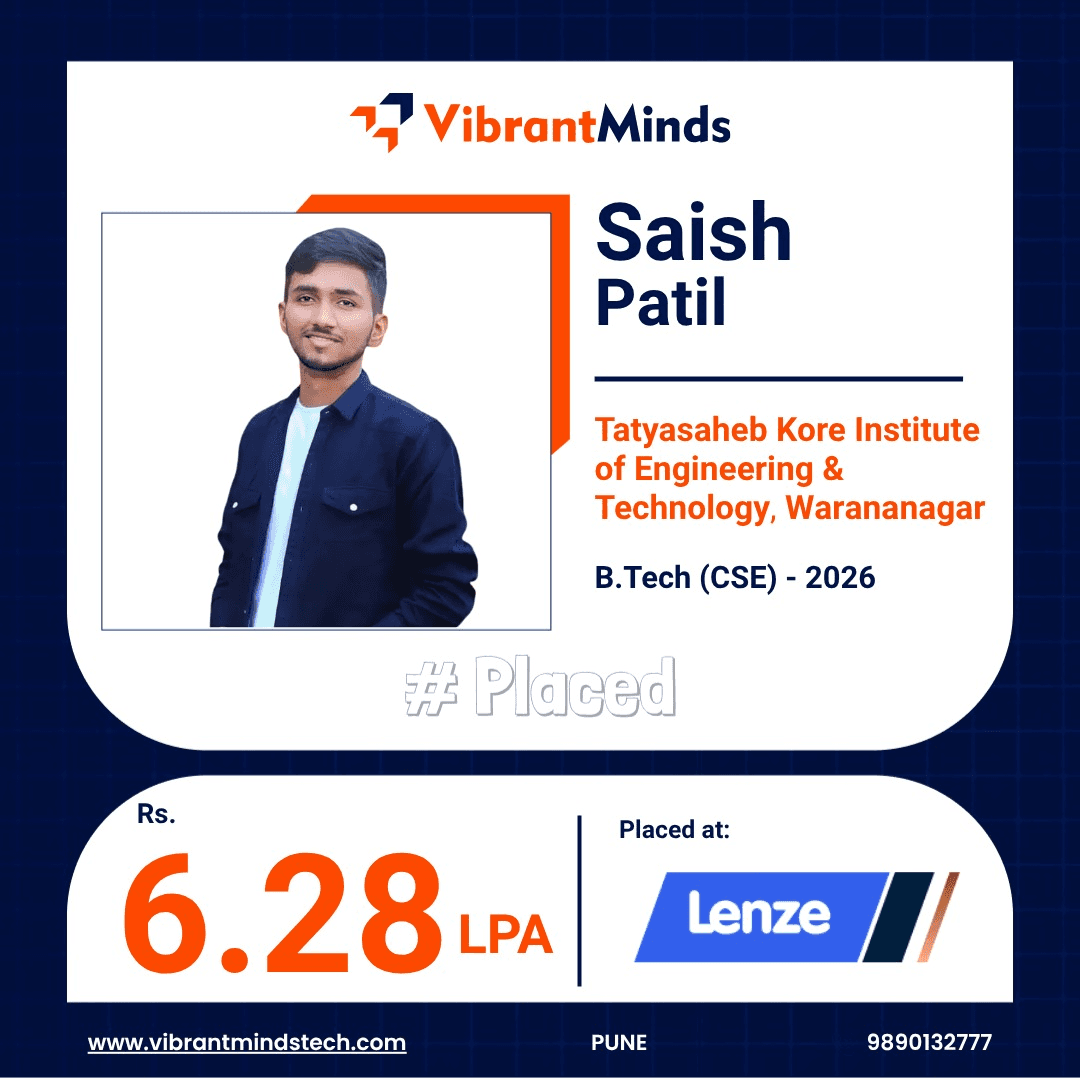
VibrantMinds also publishes student placement stories on its website, providing examples of graduates who completed its Full Stack Development program and subsequently received offers from different organizations. These examples should be viewed as individual outcomes rather than a guarantee for every student.
For a fresher looking specifically for Java Full Stack training in Pune with placement assistance, that combination of curriculum, practical training and career preparation makes VibrantMinds a course provider worth exploring.
Java Full Stack Developer Career: What Can You Target After Training?
After developing the required skills and practical experience, Java Full Stack learners can explore entry-level roles such as:
Java Developer
Junior Java Developer
Full Stack Developer
Backend Developer
Software Developer
Software Engineer
Graduate Engineer Trainee
Your actual job title will depend on your skills, educational background, interview performance and employer requirements.
The strongest candidates are usually not the ones who simply list the largest number of technologies.
They are the candidates who can demonstrate what they know.
What Should You Have Before Applying for Java Developer Jobs?
Before actively applying, try to build this checklist:
Technical Skills
Core Java
OOP
DSA
SQL
Spring Boot
REST APIs
HTML
CSS
JavaScript
Frontend framework basics
Git and GitHub
Practical Skills
At least one substantial full-stack project
Database integration
API development
Debugging
Problem-solving
Basic testing
Job Skills
Resume
Communication
Aptitude
Technical interview preparation
Project explanation
Mock interviews
If you can demonstrate these skills confidently, your profile becomes much stronger than one based only on a course certificate.
Frequently Asked Questions
Which is the best Java Full Stack Developer course with placement in Pune?
The best course depends on curriculum, practical training, projects, interview preparation and the way placement assistance is provided. VibrantMinds Technologies offers a 6-month Full Stack Java program in Pune covering Java, DSA, SQL, Spring Boot, REST APIs, frontend development, practical coding, interview preparation and placement assistance.
Is Java Full Stack a good career for freshers in 2026?
Java remains an important enterprise development platform, and current Java releases continue to evolve. For freshers, the better approach is to combine Java with SQL, DSA, Spring Boot, REST APIs, frontend development, projects and interview preparation.
Does a Java Full Stack course guarantee a job?
A training course cannot honestly guarantee that every student will be selected by an employer. Placement assistance can provide guidance, interview opportunities and recruitment support, but selection depends on the candidate and employer requirements.
Is Java Full Stack suitable for beginners?
Yes. Beginners can start with Core Java and gradually progress to SQL, DSA, Spring Boot, frontend development and projects. Consistent coding practice is essential.
What should I learn first: Java or Spring Boot?
Start with Java fundamentals. Learn OOP, collections, exception handling and programming logic before moving into Spring and Spring Boot.
Is DSA necessary for Java Developer jobs?
DSA is useful for coding assessments and technical interviews. Even when a job does not require advanced algorithms, problem-solving skills help you write better programs and approach unfamiliar problems.
How much practical training should a Java Full Stack course provide?
Look for a program where you regularly write code, solve problems, work with databases, build APIs and develop projects. Practical ability should be a major part of the learning process.
Why choose VibrantMinds for Java Full Stack training in Pune?
VibrantMinds combines Java and full-stack technical training with DSA, practical coding, SQL, projects, aptitude, communication, soft skills, interview preparation and placement assistance. Its current course information describes a six-month program delivered through classroom and online training options.
Final Thoughts
Choosing the best Java Full Stack Developer course with placement should not be about finding the course with the biggest advertisement or the most impressive promise.
Look for a program that helps you become genuinely job-ready.
You should finish your training able to:
Write Java code.
Solve programming problems.
Work with SQL databases.
Build REST APIs.
Develop Spring Boot applications.
Create frontend interfaces.
Connect frontend and backend.
Build and explain real projects.
Handle technical interviews.
Communicate your ideas confidently.
For students searching for Java Full Stack training in Pune, Java Full Stack courses with placement assistance, or a job-oriented Java Developer course, VibrantMinds Technologies provides a structured option that combines technical learning with practical development and career preparation.
The ultimate goal should not simply be to complete a Java Full Stack course.
The goal should be to become a Java Full Stack Developer who can demonstrate real skills to an employer.


