Java Full Stack vs MERN Stack for Freshers (2026): Which Should You Learn First?
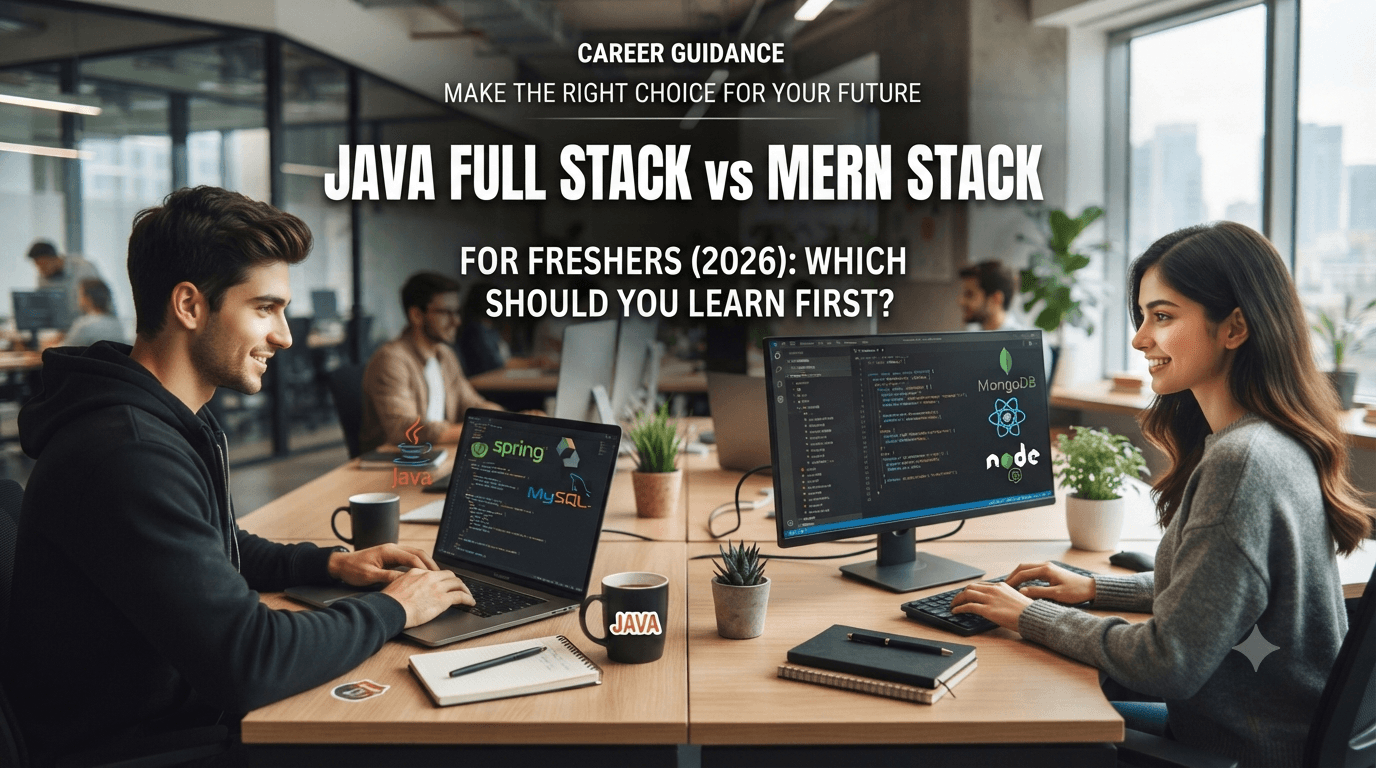
If you have been searching for Java full stack vs MERN stack for freshers, which full stack course is best for freshers, MERN stack vs Java full stack jobs in Pune, should I learn Java or JavaScript first or full stack developer roadmap for beginners, this guide settles it with a fair comparison, real code side by side, a decision method and a one-week action plan. It does not tell you one stack is “dead”. Both are alive. The question is which one fits you, today.
Choose Java Full Stack if you want structured fundamentals, strong object-oriented programming (OOP) and a path into enterprise and service-company roles, which commonly use Java and SQL.
Choose MERN if you enjoy front-end work, want to use one language (JavaScript) everywhere, and are comfortable learning with less structure.
Do not choose based on hype, a friend’s opinion or a “top 10 stacks” video.
Choose based on three things: the job openings near you, how you learn best, and how soon you want a project to show.
Sneha’s story, part 1: Sneha opened five job portals and counted roles that matched “Java” and roles that matched “MERN” in Pune. She did not trust any single number, but the pattern told her something: both stacks had openings, and many listings wanted SQL, Git and REST APIs regardless of the stack. Her real problem was not the stack. It was that she had no project.
What the Two Stacks Actually Contain
Layer | Java Full Stack (typical) | MERN Stack |
|---|---|---|
Language | Java (backend), JavaScript (front end) | JavaScript everywhere |
Front end | HTML, CSS, JavaScript, sometimes a framework | React |
Backend | Spring Boot, REST APIs | Node.js with Express |
Database | MySQL / SQL databases, JDBC, Hibernate/JPA | MongoDB (NoSQL) |
Build and tools | Maven/Gradle, Git, IDE | npm, Git, VS Code |
Typical employer type | Service companies, enterprise and banking-style projects, many product teams | Startups, web product teams, agencies, many product teams |
MERN = MongoDB, Express, React, Node.js.
Java Full Stack is not a single product. It usually means Core Java + SQL + Spring Boot + REST APIs + front-end basics, with exact content depending on the course.
Side-by-Side Comparison for Freshers
Factor | Java Full Stack | MERN |
|---|---|---|
Learning curve | Steeper at the start (OOP, types, JVM concepts) | Gentler at the start, harder to master well |
Structure | Strongly typed, strict, clear patterns | Flexible, many ways to do the same thing |
Fundamentals gained | Strong OOP, collections, exceptions, multithreading, SQL | Async programming, component thinking, JSON everywhere |
Interview style | Core Java, OOP, collections, SQL, Spring Boot | JavaScript concepts, React, REST, async/await |
Time to first visible project | Longer | Often shorter, since results appear in the browser |
Database | Relational (SQL), widely tested in interviews | Document-based (MongoDB), SQL knowledge still valued |
Career flexibility | Strong in enterprise-style environments | Strong in web-focused teams |
Best for | Learners who like structure and logic | Learners who like visual results and fast iteration |
Read this with Sneha in mind. She likes seeing results quickly but struggles when there is no structure. That is a signal, not a verdict.
The Same Feature in Both Stacks: Real Code Side by Side
A simple API endpoint: “Get a student by ID.” This is where the difference stops being abstract.
Spring Boot (Java)
java
Node.js + Express (MERN)
javascript
What to notice:
Java is more verbose but more structured. Layers (controller, service, repository) are expected.
JavaScript is shorter and more flexible, but you decide the structure, which is a risk for beginners.
The concepts are identical: routing, request parameters, database lookup, JSON response, status codes. Learn one stack deeply and the second becomes far easier.
“Learning never exhausts the mind.” — Leonardo da Vinci (attributed)
Choosing by Learning Style: A Quick Diagnostic
If this sounds like you… | Check this | Lean towards |
|---|---|---|
“I like rules and clear structure.” | You prefer guided learning | Java Full Stack |
“I like seeing the result in the browser quickly.” | You are motivated by visual feedback | MERN |
“I want to understand how things work underneath.” | You enjoy depth and fundamentals | Java Full Stack |
“I already know some JavaScript.” | You have a starting point | MERN, but add SQL |
“I want service company interviews soon.” | Core Java and SQL are tested often | Java Full Stack |
“I want to join a small startup.” | Web skills and speed are valued | MERN |
“I am a non-CS graduate.” | You need a structured base | Java Full Stack (structured path), unless you already love front-end work |
“I can’t decide at all.” | Pick the one with a mentor and a clear curriculum | Whichever you can finish |
The Decision Flow
Myths vs Reality
Myth | Reality |
|---|---|
“Java is dead.” | Java is widely used in enterprise systems and many hiring pipelines still test Core Java and SQL. |
“MERN is only for startups.” | MERN is used in many web teams, though hiring emphasis varies by company. |
“Learning two stacks at once is faster.” | Splitting focus usually delays both. Finish one before starting the other. |
“You need a CS degree for either.” | Many companies hire on skills, projects and interview performance. |
“Frameworks matter more than fundamentals.” | Frameworks change. Fundamentals such as OOP, SQL, REST and Git transfer across stacks. |
“One stack guarantees a job.” | No stack guarantees a job. Skills, projects and interview performance decide. |
What Is the Same, Whichever Stack You Choose
These carry across both, and interviewers test them:
Git and GitHub basics
REST API concepts: GET, POST, PUT, DELETE, status codes, JSON
SQL basics (joins, group by, indexes), even for MongoDB-heavy teams
Authentication basics (login, tokens, sessions)
Debugging skills and reading error messages
One or two complete projects that you can explain from database to UI
Sneha’s story, part 2: Sneha decided on Java Full Stack because she wanted structure, but she kept one rule: build a small project in her first month, not her last. She started a “student results portal” with a Spring Boot API, a MySQL database and a plain HTML/CSS/JavaScript front end. By week three something worked end to end, and her motivation changed overnight.
Interview Questions You Will Actually Face
Java Full Stack interviews often ask:
What is the difference between an abstract class and an interface?
How does HashMap work internally?
Explain exception handling in Java.
What is Spring Boot and why is it used over plain Spring?
Write a SQL query to find the second-highest salary.
MERN interviews often ask:
What is the difference between
var,letandconst?Explain the event loop and
async/await.What is the virtual DOM in React?
What are props and state?
How do you connect Express to MongoDB?
Both will ask: “Explain your project.” Prepare it in detail. A sample project answer:
“I built a student results portal with a Spring Boot REST API and a MySQL database. I designed the tables for students, subjects and marks, wrote the endpoints, and built a simple HTML and JavaScript front end to display results. The hardest part was preventing duplicate result entries, which I solved with a unique constraint on student and subject. If I had more time, I’d add login and role-based access.”
Your 7-Day Plan to Decide and Start
Day 1: Research honestly. Check job listings in your city for both stacks. Write down which skills repeat.
Day 2: Try a 2-hour sample of each. One small “Hello API” in Java and one in Node.
Day 3: Review how you felt. Which one did you finish with less frustration?
Day 4: Choose, in writing. Write one paragraph: “I choose ___ because ___.”
Day 5: Set up tools. Install your IDE, Git, a database and create a GitHub account.
Day 6: Plan your first project. Pick a small, real idea and list its features.
Day 7: Start building. Even one table and one endpoint counts. Commit it to GitHub.
Sneha’s story, part 3: Six months later Sneha could explain her project from the database table to the browser screen, answer Core Java and SQL questions confidently, and had learned enough JavaScript to read a React codebase. She did not “win” the Java vs MERN debate. She stopped debating and started building, which was the only argument that mattered.
How VibrantMinds Helps Freshers Who Choose the Java Full Stack Path
VibrantMinds Technologies Pvt. Ltd. trains freshers in Pune for Java-based full stack roles and supports them through the placement process.
Structured Java Full Stack training: The course covers Core Java, OOP, JDBC, SQL, Spring Boot, REST APIs and front-end basics (HTML, CSS, JavaScript) with project work, so you learn the same layers shown in the code comparison above, in order.
Projects you can explain: Building an end-to-end project with an API, a database and a user interface gives you the interview story Sneha needed.
Aptitude, communication and interview preparation are part of the programme, so you prepare for every round, not just the coding one.
Placement support: The placement pipeline includes screening, drive coordination and interview support. Check the campus-drives portal at https://candidates.vibrantminds.in/ for what is open now.
Honesty first: VibrantMinds offers placement support, not a guaranteed job, and no legitimate recruiter should ask you to pay to be interviewed.
VibrantMinds works as a talent ecosystem connecting candidates, colleges and companies, with 1900+ partner colleges and 600+ hiring companies. Learn more on the official website: https://vibrantminds.in/
If you are still unsure, call or visit and talk it through with the team before enrolling.
VibrantMinds Courses at a Glance
Course | Duration | Key topics |
|---|---|---|
Full Stack Java Development | 4 to 6 months | Core Java, OOP, JDBC, SQL, Spring Boot, REST APIs, front-end basics, projects, aptitude and interview preparation |
Software Testing (Manual + Automation) | 2 to 5 months | Test cases, STLC, bug tracking, SQL, Selenium basics |
Core Java | 1 to 2 months | Syntax, OOP, collections, exceptions, strings |
Python & Data Science | 2 to 4 months | Python basics, data handling, analysis fundamentals |
Fees, syllabus and batch dates are on https://candidates.vibrantminds.in/. Please confirm them directly before enrolling.
The VibrantMinds Placement Pipeline: Six Steps
Real Outcomes: What to Expect and What Not To
Past students have shared positive feedback about the training and support, and have gone on to roles at companies such as Aress Software and Education Technologies, Saama Technologies and Three M Software. Results vary by candidate, skill level, effort and market conditions, so please confirm details directly with the VibrantMinds team. No one can honestly promise a guaranteed job.
Join the VibrantMinds WhatsApp Groups for Fresher Job and Drive Alerts
Fresher openings, campus drives and walk-in interviews are shared here as they come in. Join whichever group has space; all three carry the same type of updates.
VibrantMinds Fresher IT Jobs, Group 1: https://chat.whatsapp.com/CUCS1derlmTFee2c9dyUHd
VibrantMinds Fresher IT Jobs, Group 2: https://chat.whatsapp.com/FvMf1fGYQYnHppQ8AwFX40
VibrantMinds Fresher IT Jobs, Group 3: https://chat.whatsapp.com/I7RNnGMkb2L8S8HibdyWpQ
Never pay to apply. Legitimate recruiters do not charge candidates for tests, interviews or offer letters. Do not share sensitive personal or financial details in any group chat.
Visit or Contact VibrantMinds in Pune
Company: VibrantMinds Technologies Pvt. Ltd.
Address: Viva Academy Building, Warje, Pune, Maharashtra 411052
Phone: +91 95035 79517
Email: support@vibrantmindstech.com
Website: https://vibrantminds.in/
Candidate portal and courses: https://candidates.vibrantminds.in/
Frequently Asked Questions
Which is better for freshers, Java full stack or MERN stack?
Neither is better for everyone. Java full stack suits learners who want structure and enterprise-style roles, while MERN suits learners who prefer fast visual results and web-focused teams. Choose based on local job openings, your learning style and the project you can finish.
Is Java full stack still in demand in 2026?
Yes, Java remains widely used in enterprise software, and many fresher hiring pipelines still test Core Java, OOP and SQL. Demand varies by company and city, so check current listings.
Can I learn MERN without knowing Java?
Yes. MERN uses JavaScript throughout, so Java is not required.
Should I learn both Java and MERN?
Eventually it can help, but learn one stack well before starting the second. Fundamentals like REST, SQL and Git transfer between them.
Which stack is easier for beginners?
MERN often feels easier at the start because results appear quickly in the browser, while Java feels harder at first but gives stronger fundamentals. “Easier” depends on your background.
Which pays more for freshers, Java or MERN?
Fresher pay depends on the company, role and your interview performance more than on the stack. Treat any salary comparison as indicative and rely on actual offer letters.
Do I need SQL for MERN stack jobs?
Often yes. Even when a project uses MongoDB, many interviews and teams expect SQL knowledge, so learn it either way.
Can a non-CS graduate learn Java full stack?
Yes. Many non-CS graduates enter IT through structured training and projects. Plan for consistent practice and a clear project portfolio.
How long does it take to learn Java full stack?
Courses commonly run around four to six months, followed by project practice and interview preparation. Your starting level and daily practice matter more than any fixed timeline.
Does VibrantMinds teach MERN stack?
VibrantMinds’ main fresher programme is Full Stack Java Development, including front-end basics. Please check the candidate portal or contact the team for the current syllabus and any other tracks. VibrantMinds does not guarantee a job.
Final Thoughts:
Pick one. Build one project. Explain it clearly. Then grow.
If you are in Pune and want a guided Java full stack path with placement support, visit https://vibrantminds.in/, check the candidate portal at https://candidates.vibrantminds.in/, and join the WhatsApp groups above for the next drive.