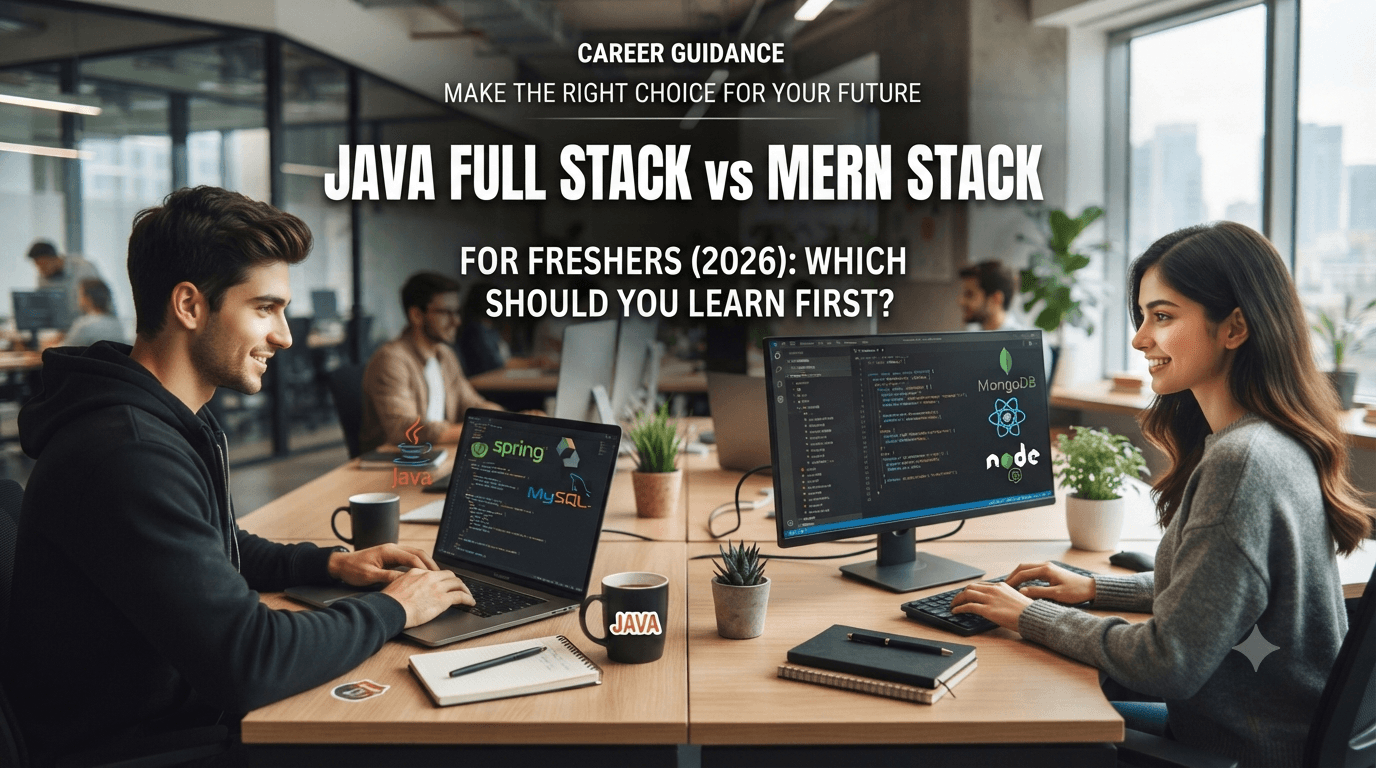
IT Career Roadmap for Freshers in 2026: How to Choose the Right Software Job Role

Choosing an IT career can be harder than learning the first programming language.
A fresher may hear about Full Stack Development, Java Development, .NET, Python, Data Analytics, Testing, Cloud, AI and other technology careers and wonder: Which one should I choose? What should I learn first? Will this career be suitable for me?
This confusion often leads to an unproductive cycle. A student starts learning one technology, switches to another after a few weeks, collects several courses, and eventually has a long list of partially learned skills without a clear career direction.
A better approach is to choose the job role first and the technology stack second.
This IT career roadmap for freshers in 2026 explains how to evaluate different software career paths, choose one based on your interests and strengths, and create a practical preparation plan.
Quick Answer: How Should Freshers Choose an IT Career?
Freshers should choose an IT career by considering their interests, existing strengths, preferred type of work, learning ability and the skills required for the target role. Instead of trying to learn every technology, select one job role, understand its core skills, build practical projects, prepare for interviews and gradually develop deeper expertise.
Why Choosing a Career Direction Matters
Imagine starting your journey with this goal:
"I want to learn everything in IT."
It sounds ambitious, but it does not give you a practical starting point.
Now compare it with:
"I want to become a Java Full Stack Developer."
The second goal immediately gives you a learning direction.
You can identify:
Which programming language to learn
Which database concepts to study
Which frameworks are relevant
What type of projects to build
Which interview questions to practice
What kind of resume to create
Which entry-level roles to target
A clear target does not mean you have to follow the same technology forever. It simply gives you a focused starting point.
IT Career Paths Freshers Can Explore
There is no single "best" IT career for every fresher.
Different roles require different strengths.
IT Career Path | Main Focus | Suitable for Candidates Interested In |
|---|---|---|
Full Stack Development | Frontend + Backend + Database | Building complete web applications |
Backend Development | APIs, business logic, databases | Server-side programming |
Frontend Development | User interfaces and web experiences | Designing interactive applications |
Software Testing | Quality, test cases and defects | Finding problems and improving software quality |
Data Analytics | Data, SQL and analysis | Working with data and business insights |
Cloud & DevOps | Infrastructure, deployment and automation | Systems, deployment and development operations |
AI & Machine Learning | Models, data and intelligent systems | Mathematics, programming and AI applications |
The right choice depends on the individual.
Do not select a career simply because someone says it is popular.
Select a direction you are willing to learn deeply and practice consistently.
1. Start With the Type of Work You Enjoy
Before choosing a technology, think about the kind of work you naturally enjoy.
Ask yourself:
Do You Like Building Applications?
If you enjoy creating websites, applications and software features, development could be a suitable direction.
You may explore:
Frontend Development
Backend Development
Full Stack Development
Do You Enjoy Finding Problems?
If you naturally notice errors and like checking whether something works correctly, software testing may interest you.
Do You Enjoy Working With Data?
If you like numbers, patterns, databases and drawing conclusions from information, data-related roles may be worth exploring.
Do You Enjoy Systems and Infrastructure?
If servers, deployment, automation, networking and infrastructure interest you, cloud or DevOps could be a direction to investigate.
Do You Enjoy Mathematics and Intelligent Systems?
If you enjoy programming, mathematics, statistics and machine learning concepts, AI and machine learning can be explored as a longer-term specialization.
You do not need to know the answer immediately.
Explore each area enough to understand what the actual work looks like.
2. Understand the Difference Between a Technology and a Job Role
This is one of the most important concepts for freshers.
Java is a technology.
Full Stack Developer is a job role.
SQL is a skill.
Backend Developer is a job role.
React is a technology.
Thinking in terms of roles makes your preparation much clearer.
For example, if your target is Java Full Stack Development, learning Java alone is not enough.
Your preparation may include:
Programming → Java → SQL → Backend Framework → REST APIs → Frontend → Database → Projects → Interview Preparation
This gives you a career-oriented learning path instead of a collection of unrelated technologies.
3. What Should a Fresher Learn for Full Stack Development?
Full Stack Development is a popular career direction for candidates who want to understand both frontend and backend development.
A beginner-oriented roadmap can look like this:
Foundation
Start with:
Programming fundamentals
Variables and data types
Conditions
Loops
Functions or methods
Object-oriented programming
Basic problem-solving
Database
Learn:
SQL
Tables
Relationships
Joins
Constraints
CRUD operations
Transactions
Database design fundamentals
Backend
Depending on your selected technology stack, learn:
Server-side programming
Framework fundamentals
REST APIs
Authentication
Validation
Exception handling
Database connectivity
Frontend
Understand:
HTML
CSS
JavaScript
Responsive design
API integration
A relevant frontend framework where required
Practical Development
Then bring everything together through projects.
The important point is that these skills should not remain separate subjects.
You should understand how they work together inside an application.
4. Should Freshers Learn Java, Python, or JavaScript First?
There is no universal answer.
The better question is:
Which technology supports the career path I want to pursue?
For example:
Java can be a strong foundation for candidates targeting Java-based development roles.
JavaScript is essential for modern web development and can support both frontend and backend paths.
Python can be useful across several areas, including development, automation, data and AI.
Do not choose a language simply because you saw it in a social media post.
Choose based on your target role and then build sufficient depth.
5. Don't Change Your Career Path Every Two Weeks
Frequent switching is one of the biggest problems beginners face.
A typical pattern looks like this:
Java → Python → AI → Web Development → Cloud → Data Science → Java again
Every new technology looks exciting at the beginning.
But constantly switching prevents you from reaching the level where you can actually build something independently.
Instead, use a simple rule:
Explore briefly → Choose carefully → Commit consistently → Review later
Give yourself enough time to understand whether a career path suits you before abandoning it.
6. Build Skills in Layers
You do not have to learn everything simultaneously.
Think of your career preparation like building a house.
Layer 1: Fundamentals
Understand programming and logical thinking.
↓
Layer 2: Core Technology
Become comfortable with your chosen language.
↓
Layer 3: Supporting Skills
Learn SQL, Git, APIs, databases and other relevant tools.
↓
Layer 4: Framework
Learn the framework used with your target technology.
↓
Layer 5: Projects
Build applications using what you learned.
↓
Layer 6: Interview Preparation
Practice technical, coding, communication and HR questions.
This approach makes your learning more manageable.
7. Projects Should Match Your Target Job
Your projects should support your career direction.
If you want to become a developer, build software.
If you want to demonstrate backend skills, build applications with meaningful APIs and database operations.
If you want to demonstrate frontend skills, create interfaces that solve real user problems.
For example, a full stack fresher could build:
Employee Management Application
Possible features:
User authentication
Employee registration
Employee profiles
Search and filtering
CRUD operations
Database integration
REST APIs
Form validation
Error handling
The project does not need hundreds of features.
It needs to demonstrate that you understand how software is designed, developed and connected.
8. Don't Choose a Career Based Only on Salary
Salary is naturally an important consideration.
However, it should not be your only decision factor.
A career that looks attractive financially may still be a poor choice if you strongly dislike the actual work.
Instead, evaluate:
Interest + Skill Fit + Learning Curve + Career Opportunities + Long-Term Growth
Then consider compensation as one part of the decision.
Also remember that entry-level compensation varies based on factors such as role, location, technical ability, company, interview performance and experience.
There is no single salary that every fresher in a particular IT role will receive.
9. What If You Have a Non-IT Background?
A non-IT academic background does not automatically prevent you from developing an IT career.
However, you may need to be more deliberate about building your technical foundation.
Start with:
Basic programming
Logical problem-solving
SQL
Your selected technology stack
Practical projects
Resume preparation
Technical interviews
Communication skills
Do not try to hide your academic background.
Instead, focus on demonstrating what you can do now.
A strong project, clear technical understanding and good interview preparation can help you communicate your transition more effectively.
10. How Long Does It Take to Become Job-Ready?
There is no universal timeline.
It depends on:
Your starting level
Hours of practice
Learning method
Technical complexity of the role
Previous programming knowledge
Project experience
Interview preparation
Consistency
Someone who studies consistently and practices daily may progress faster than someone who spends months watching tutorials without writing code.
Instead of asking:
"How many months will it take?"
Ask:
"What can I demonstrate at the end of each stage?"
For example:
Stage 1: I can write basic programs.
Stage 2: I can solve beginner-level problems.
Stage 3: I can work with a database.
Stage 4: I can build a functional application.
Stage 5: I can explain my project.
Stage 6: I can handle technical interviews.
That is a more meaningful way to measure progress.
11. A Practical IT Career Roadmap for Freshers
If you are starting from the beginning, use this general framework.
Month 1: Build the Foundation
Focus on:
Programming basics
Logical reasoning
Basic problem-solving
Git fundamentals
Basic SQL
Month 2: Develop Core Technical Skills
Go deeper into your chosen technology.
For a Java-focused path, this could include:
Core Java
OOP
Collections
Exception handling
Java fundamentals
SQL practice
Month 3: Learn Application Development
Move from isolated concepts to application development.
Explore:
Backend fundamentals
Framework concepts
REST APIs
Database integration
Frontend fundamentals
Month 4: Build Projects
Create practical applications.
Focus on:
Functionality
Clean structure
Database integration
API communication
Validation
Debugging
Month 5: Interview Preparation
Practice:
Coding questions
Technical concepts
SQL
Project explanation
Communication
HR questions
Mock interviews
Month 6: Apply and Improve
Start applying to relevant entry-level roles while continuing to improve.
Track:
Applications
Interview questions
Weak technical areas
Coding mistakes
Resume improvements
The timeline can be shorter or longer depending on your starting point. The important part is the sequence, not the exact number of months.
12. What Should You Do Every Day?
A good daily routine does not need to involve studying for ten different subjects.
For example:
Technical Learning — 2 hours
Learn one important concept.
Coding Practice — 1 hour
Solve programming problems.
Project Work — 1–2 hours
Apply your knowledge.
Communication — 30 minutes
Practice explaining concepts or speaking about your project.
Revision — 30 minutes
Review what you learned earlier.
The exact schedule can change based on your availability.
Consistency matters more than following someone else's timetable perfectly.
How VibrantMinds Can Support Your IT Career Preparation
Choosing a career path is easier when your learning is structured around a clear outcome.
VibrantMinds Technologies provides structured IT training and career preparation for candidates who want to develop practical, job-relevant skills.
For candidates interested in Java Full Stack Development, the learning path can bring together Core Java, Advanced Java, Java 8, DSA, SQL, Hibernate, Spring, Spring Boot, REST APIs, Spring MVC, HTML, CSS and JavaScript.
Technical preparation can also be supported through aptitude and logical reasoning, communication development, group discussions, soft-skill training and interview preparation.
The value of structured training is not simply having a list of subjects to complete. The objective should be to create a connected learning journey where technical concepts, practical development and interview preparation support each other.
Common Mistakes Freshers Should Avoid
Learning Without a Career Target
If you do not know what role you are preparing for, your learning can become scattered.
Following Every New Technology
New technologies will continue to appear. You do not need to learn all of them immediately.
Watching Tutorials Without Practicing
Watching someone build an application is different from building one yourself.
Building Projects You Cannot Explain
Every project on your resume should be something you understand.
Ignoring Communication
Technical knowledge becomes difficult to demonstrate if you cannot explain your thinking.
Waiting Until You Feel Completely Ready
You will always have something more to learn. Start applying once you have built a reasonable foundation and continue improving.
How to Know Whether You Chose the Right IT Career
You do not need absolute certainty.
Look for practical signs.
You may be moving in the right direction if:
You enjoy learning the subject.
You are becoming better with practice.
You can solve problems independently.
You enjoy building or working with the technology.
You can imagine doing this type of work professionally.
You are willing to continue learning it.
Your skills are becoming stronger over time.
If you discover that a particular path genuinely does not suit you, changing direction is possible.
The important thing is to make the decision based on experience rather than constantly switching based on trends.
Frequently Asked Questions
Which IT career is best for freshers in 2026?
There is no single best IT career for every fresher. Full stack development, backend development, frontend development, testing, data-related roles, cloud and other technology careers can suit different candidates depending on their interests and skills.
Should I choose a job role before learning a programming language?
Yes. Choosing a target role first can make it easier to identify which programming language, frameworks and supporting skills you actually need.
Is Full Stack Development suitable for beginners?
It can be suitable for beginners who are interested in building complete web applications. However, it requires learning multiple connected areas, including frontend, backend, databases and APIs.
Should freshers learn multiple programming languages?
Not necessarily. Strong fundamentals in one relevant language are generally more useful than shallow knowledge of several languages.
How many projects should a fresher build?
There is no fixed number. A few meaningful projects that demonstrate relevant skills and that you can explain confidently are more useful than a large collection of projects you barely understand.
Can I switch from one IT career path to another later?
Yes. Technology careers evolve, and professionals often learn new technologies or move into related roles. Building strong fundamentals makes future transitions easier.
Do I need a computer science degree for an IT career?
Requirements vary by role and employer. A relevant degree can be useful, but candidates should also focus on developing demonstrable technical skills, practical experience and interview readiness.
How can I choose between frontend and backend development?
Think about the type of work you enjoy. Frontend development focuses heavily on user interfaces and experiences, while backend development focuses more on application logic, APIs, databases and server-side systems. Exploring both through small projects can help you decide.
Should I learn AI if I want to become a software developer?
Learning how AI tools and AI-enabled development workflows work can be useful, but it should not replace programming fundamentals. First build a strong foundation in your target development role.
When should a fresher start applying for jobs?
Start applying once you have a reasonable foundation for your target role, a focused resume and at least some practical work to discuss. Continue learning and improving while applying.
Final Thoughts
Your first IT career decision does not have to determine your entire professional life.
What matters is choosing a clear starting direction and developing enough depth to become useful in that role.
Do not begin with:
"Which technology should I learn?"
Begin with:
"Which type of IT work do I want to become good at?"
Then work backward.
Choose the role. Identify the skills. Learn the fundamentals. Build projects. Practice problem-solving. Improve communication. Prepare for interviews. Start applying. Learn from every opportunity.
For freshers in 2026, a focused approach can be far more effective than trying to learn the entire IT industry at once.
Choose one direction, build real skills, and let your abilities—not the number of technologies on your resume—define your preparation.