Group Discussion (GD) Round for IT Freshers: How to Crack It in Placement Drives (2026)

What Evaluators Score, Common Topics, and a Practical Preparation Plan
The group discussion round trips up more technically capable freshers than almost any other stage of a placement drive — not because the topics are hard, but because most candidates have never practiced speaking clearly under mild group pressure with an evaluator watching. This guide covers exactly what GD panels are scoring, the topics that come up most often in IT placement drives, and a practical way to prepare in the days before your next drive.
What GD Evaluators Are Actually Scoring
Freshers often assume a GD is about "winning" the argument or speaking the most. In reality, evaluators are scoring a fairly specific, consistent set of behaviors:
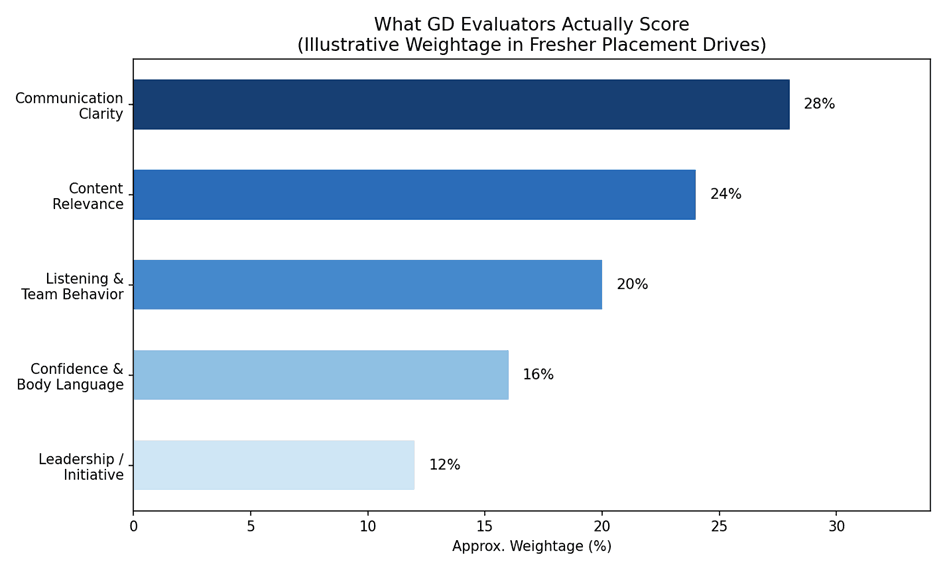
• Communication clarity — can you make a point concisely and understandably, without rambling
• Content relevance — are your points actually relevant to the topic, not generic filler
• Listening and team behavior — do you build on others' points or talk over them
• Confidence and body language — posture, eye contact, and tone, even in a virtual GD
• Leadership and initiative — summarizing the discussion or steering it constructively when it stalls, without dominating
How Much You Should Actually Speak
One of the most common fresher mistakes is either staying almost silent, or trying to dominate the conversation. In a typical panel of 7-8 candidates given around 15 minutes, a fair, effective speaking share looks roughly like this:
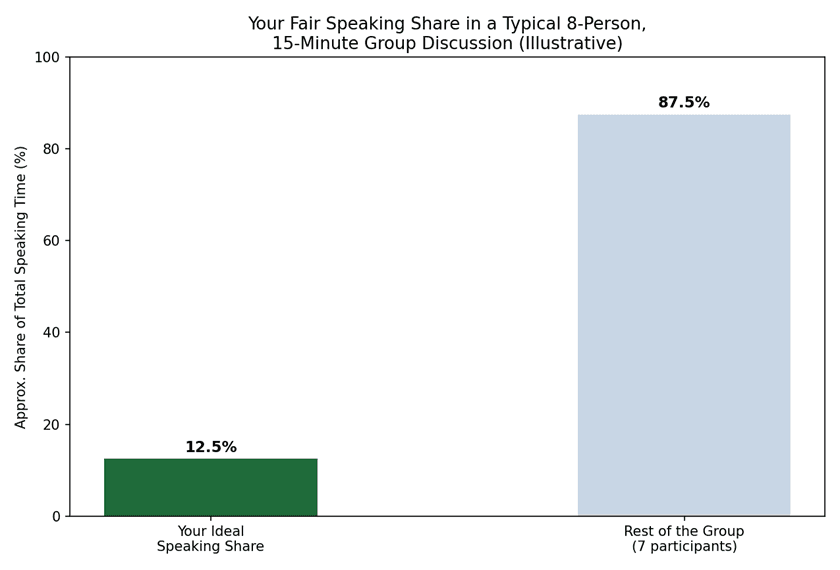
Speaking roughly your proportional share, but doing it with clear, well-structured points, consistently outperforms both over-dominating the discussion and staying quiet out of nervousness. Two or three sharp, relevant contributions are worth far more than ten scattered interruptions.
Common GD Topics in IT Placement Drives
Topic Category | Example Topics |
Technology & AI | "Will AI replace software developers?", "Is remote work still relevant for IT teams?" |
Education & Careers | "Are certifications more valuable than a degree?", "Should coding be taught from school level?" |
Current Affairs | Recent, general-interest news topics relevant to business or technology |
Abstract / Opinion-Based | "Is failure necessary for success?", "Does social media do more harm than good?" |
Case-Study Style | A short business or workplace scenario, asking the group to discuss possible approaches |
A Simple Framework for Structuring What You Say
• Open with a clear, one-line stance or observation rather than a vague opening filler
• Support it with one concrete example or reason, not three underdeveloped ones
• Reference another participant's point directly when you can — "building on what X said..." — this signals active listening, which evaluators specifically watch for
• If the discussion stalls or repeats itself, offer to summarize the points made so far — this is a low-risk way to show initiative without needing to dominate
• Close your individual points cleanly rather than trailing off — a confident stop is better than an uncertain fade
Common Mistakes Freshers Make in GD Rounds
• Interrupting other speakers repeatedly, which evaluators consistently score down regardless of how good the point was
• Preparing a fixed opinion in advance and refusing to engage with counterpoints raised by others
• Staying silent for the first several minutes out of nervousness, then trying to force an entry late
• Using generic, memorized opening lines that add no real content
• Focusing entirely on English fluency and ignoring actual point quality and relevance
How to Prepare in the Days Before a GD Round
• Read a general news summary daily for a week beforehand, so you have current, real examples ready for common topic categories
• Practice with 4–5 peers on a mock topic, timing yourselves to simulate real pressure
• Record yourself speaking on a topic for two minutes and review your clarity, filler words, and pacing
• Prepare a small mental list of 8–10 flexible, real-world examples that can apply across multiple topic categories
How VibrantMinds Technologies Builds GD Practice Into Training
VibrantMinds Technologies, a Pune-based IT training and placement company, includes dedicated group discussion and spoken English practice as part of its Full Stack Java program, alongside its core technical syllabus covering Core Java, Advanced Java, Spring Boot, REST APIs, and SQL. The company states partnerships with 1900+ colleges and 600+ companies across India, and runs a six-stage placement pipeline — requirement mapping, candidate sourcing, screening & assessment, drive coordination, interview support, and onboarding follow-up — behind its campus and off-campus drives. Training runs both at its Warje, Pune campus and via live online batches. Everything above is drawn from VibrantMinds' own published pages; confirm current details directly before enrolling.
Official Website: https://vibrantminds.in/
Candidate Portal & Courses: https://candidates.vibrantminds.in/
Join VibrantMinds WhatsApp Groups for Fresher IT Job Alerts
VibrantMinds runs WhatsApp groups sharing fresher IT job openings, campus drives, and walk-in interview updates. These are open to any fresher, whether or not you're currently enrolled in a course.
VibrantMinds Fresher IT Jobs — Group 1: https://chat.whatsapp.com/CUCS1derlmTFee2c9dyUHd
VibrantMinds Fresher IT Jobs — Group 2: https://chat.whatsapp.com/FvMf1fGYQYnHppQ8AwFX40
VibrantMinds Fresher IT Jobs — Group 3: https://chat.whatsapp.com/I7RNnGMkb2L8S8HibdyWpQ
Frequently Asked Questions
Q: Is it bad to stay quiet in a GD round? Yes — silence is consistently scored lower than a few clear, relevant contributions, even if you're worried about saying something imperfect.
Q: What if I disagree with the group's overall direction? Disagreeing respectfully with a clear reason is fine, and often stands out positively — the key is engaging with others' points rather than simply repeating your own view.
Q: Do virtual GD rounds get evaluated differently than in-person ones? The core criteria stay the same, though clarity of audio, not talking over others on a call, and visible engagement (nodding, eye contact with the camera) matter more in virtual formats specifically.
Q: How do I recover if I get a slow start in the discussion? Look for a natural pause and enter with a specific, well-formed point rather than forcing your way in — one strong late entry outperforms a rushed, weak early one.
Bottom Line
The GD round rewards clear, relevant, well-timed contributions far more than volume or aggression. Speak roughly your fair share, build on what others say, and prepare a flexible set of real examples rather than a rigid script. Structured practice — ideally with real mock GDs under time pressure — closes most of the gap between a fresher who freezes and one who performs confidently when it counts.