Best Full Stack Developer Coaching Institute in Pune with Job-Oriented Training & Placement Support in 2026

Choosing the best Full Stack Developer coaching institute in Pune with a job guarantee is an important decision for freshers who want to start a career in software development.
But before choosing any institute, students should look beyond advertisements and ask a more important question:
Does the training actually help me become job-ready?
A strong Full Stack Developer course should not only teach programming languages. It should help students understand frontend development, backend development, databases, APIs, Git, projects, problem-solving, coding assessments and technical interviews.
For students searching for Full Stack Developer courses in Pune, Full Stack Java training in Pune, Java Full Stack courses with placement, job-oriented IT courses in Pune, or placement-focused software development training, VibrantMinds Technologies is one institute worth evaluating.
VibrantMinds currently describes itself as an IT training, recruitment, campus recruitment and placement-support organization. Its website states that it has worked with 91,000+ candidates, 600+ hiring partners and 1,900+ partner colleges and offers job-oriented training programs for freshers.
Most importantly, its placement policy provides an important clarification: placement assistance is provided, but employment itself is not guaranteed. This distinction is important for students comparing institutes that advertise a “job guarantee.”
Why Is Choosing the Right Full Stack Developer Course Important?
Full Stack Development is broader than learning one programming language.
A professional Full Stack Developer needs to understand how different parts of a web application communicate with each other.
A typical application involves:
Frontend → API → Backend → Business Logic → Database → Testing → Deployment
For example, when a user logs into an application:
The frontend collects the username and password.
The request is sent to the backend through an API.
The backend validates the request.
The database is accessed.
The server returns a response.
The frontend displays the result.
A good Full Stack Developer training program in Pune should therefore teach students how these components work together.
This is why a course that only teaches HTML, CSS and basic JavaScript may not be enough for someone targeting a professional software development role.
What Should the Best Full Stack Developer Course in Pune Include?
Before joining any Full Stack Development institute in Pune, check whether the program provides training in the following areas.
Frontend Development
Students should understand:
HTML5
CSS3
JavaScript
Responsive web development
DOM
Forms and validation
Modern JavaScript concepts
React.js or another relevant frontend framework
Backend Development
Students should learn how to:
Build server-side applications
Create REST APIs
Implement business logic
Connect applications with databases
Handle errors
Implement authentication
Work with backend frameworks
Database Development
A Full Stack Developer should understand:
SQL
MySQL
Database relationships
Joins
CRUD operations
Queries
Data modelling
Database integration
Programming and Problem Solving
Programming fundamentals and DSA are particularly important for fresher coding assessments and technical interviews.
Development Tools
Modern development also involves tools such as:
Git
GitHub
Postman
Docker
Development environments
API testing tools
Projects
Most importantly, students should build practical applications instead of completing the course with only theoretical knowledge.
Why Consider VibrantMinds Technologies for Full Stack Development Training in Pune?
VibrantMinds Technologies has positioned its training around the combination of technical education, practical learning, employability preparation and placement support.
Its current website highlights four major areas:
Training & Upskilling
Industry-focused technical training, Full Stack Java Development, practical learning and technical skill development.
Recruitment & Talent Solutions
Candidate sourcing, screening, technical and aptitude assessments, campus recruitment and hiring support.
College & Employability Programs
Technical and soft-skills training, campus drives, workshops and industry-connect programs.
Placement & Career Support
Aptitude preparation, technical preparation, mock interviews, resume preparation, interview preparation and job opportunities.
This combination is valuable for freshers because the transition from college to the IT industry requires more than technical knowledge.
You need to learn the technology and understand how to present your skills to employers.
VibrantMinds by the Numbers
One of the strongest trust factors students should evaluate is transparency.
According to the current VibrantMinds website, the organization reports:
Metric | Current Website Information |
|---|---|
Candidates | 91,000+ |
Hiring Partners | 600+ |
Partner Colleges | 1,900+ |
Job-Ready Courses | 11+ |
Google Rating | 4.9/5 |
These figures are published on the organization's current homepage.
The website also displays student placement stories and recruitment-drive information, allowing prospective students to look beyond course advertisements and examine examples of candidate outcomes.
What Courses Does VibrantMinds Offer?
The current VibrantMinds courses page lists several job-oriented programs and a free placement program. These include Full Stack Development, Data Science & AI/ML, Data Analytics, Software Testing and the Free Placement Program.
1. Full Stack Development
This is the most relevant program for students who want to become software developers.
The course focuses on frontend and backend technologies, with the current detailed Full Stack Java page describing training in:
Core Java + Advanced Java + Java 8+ + DSA + SQL + Hibernate + Spring + Spring Boot + REST APIs + HTML + CSS + JavaScript + React + Git/GitHub + Postman + Docker
The detailed course page currently describes the program as a 6-month Full Stack Java course in Pune, available through classroom and online training.
2. Data Science & AI/ML
The current courses page describes this program as a 3-month Data Science & AI/ML course covering Python, Machine Learning and Deep Learning fundamentals, aimed at students interested in data science and ML-oriented career paths. The listed eligibility is graduates with a mathematics/statistics background.
3. Data Analytics
The Data Analytics program is currently listed as approximately 2.5 months and focuses on:
Excel
SQL
Power BI
Python
Data analysis
Dashboard development
It is positioned for graduates interested in entry-level analytics careers.
4. Software Testing
The current course listing describes a 2-month Software Testing program covering:
STLC
Manual Testing
Automation basics
QA concepts
Industry-oriented testing preparation
Placement support
The listed eligibility is any graduate.
5. Free Placement Program
VibrantMinds also lists a Free Placement Program for freshers. The program includes:
Resume building
Mock interviews
Aptitude preparation
Access to live recruitment drives
Placement support
The current listing states that the program is free and available online.
The homepage also advertises 11+ job-ready courses, while the current all-courses page presents the major programs listed above.
Deep Dive: VibrantMinds Full Stack Java Developer Course
For students specifically searching for a Java Full Stack Developer course in Pune, this is one of the most detailed programs offered by VibrantMinds.
The current course page describes a 6-month program combining technical development with job-readiness preparation.
The technical journey can be understood as:
Java Fundamentals → DSA → Advanced Java → SQL → Hibernate → Spring → Spring Boot → REST APIs → Frontend → Full Stack Projects → Interview Preparation
Let's look at the major components.
1. Core Java Programming
The first stage focuses on building a strong programming foundation.
Students learn concepts such as:
Java fundamentals
Variables and data types
Operators
Conditional statements
Loops
Pattern programming
Classes and objects
Inheritance
Abstraction
Encapsulation
Polymorphism
Strings
Arrays
Exception handling
Multithreading
Java Collections
The objective is not simply to memorize Java syntax.
Students need to understand why a concept is used and where it can be applied.
For example, knowing inheritance theoretically is different from using inheritance correctly while designing a real application.
2. Data Structures and Algorithms
DSA is another important component of the program.
The curriculum includes:
Arrays
Linked Lists
Stacks
Queues
Linear Search
Binary Search
Sorting
Selection Sort
Bubble Sort
Insertion Sort
Quick Sort
Merge Sort
Recursion
The purpose is to improve programming logic, problem-solving and coding-assessment preparation.
For freshers, DSA can be particularly useful during technical interviews and coding tests.
3. Java 8+ and Functional Programming
Modern Java development requires more than traditional Core Java.
The program includes concepts such as:
Functional interfaces
Lambda expressions
Method references
Stream API
Filtering
Mapping
Sorting
Intermediate operations
Terminal operations
Aggregation
Reduction
These concepts are widely used when writing modern Java applications.
4. JDBC, Servlets and JSP
Students also learn traditional Java web development concepts, including:
JDBC
CRUD operations
Servlet lifecycle
HTTP requests and responses
JSP
Session management
Database-connected web applications
This helps learners understand how Java applications communicate with databases and handle web requests.
5. Hibernate and ORM
Database interaction is a major part of backend development.
The curriculum includes:
Hibernate configuration
Session and SessionFactory
Annotations
Object states
Caching
Relationships
Fetching
HQL
CRUD applications
Understanding ORM helps developers work with Java objects and relational databases more efficiently.
6. Spring Framework
Spring is an important part of enterprise Java development.
The course covers concepts including:
Inversion of Control
Dependency Injection
Spring Beans
Bean scopes
Bean lifecycle
Spring JDBC
Spring-Hibernate integration
Annotation-based configuration
Spring MVC
Form validation
This stage moves students from basic Java programming toward structured enterprise application development.
7. Spring Boot and REST API Development
Spring Boot is one of the most important technologies for modern Java backend development.
The curriculum covers:
Spring Boot fundamentals
Project structure
Application properties
Dependency Injection
REST Web Services
JSON
Exception handling
REST API design
Database-connected APIs
CRUD APIs
Spring Boot with Hibernate
This allows students to progress toward building actual backend applications rather than simply writing standalone Java programs.
8. SQL and MySQL
A Full Stack Developer must understand databases.
The Java Full Stack curriculum includes:
SELECT statements
WHERE conditions
Sorting
DDL
DML
Constraints
INSERT
UPDATE
DELETE
Joins
Subqueries
Aggregate functions
String functions
Conversion functions
Students therefore get exposure to both programming and database development.
9. HTML, CSS and JavaScript
Backend knowledge alone does not make someone a Full Stack Developer.
The program also covers frontend development.
Students learn:
HTML5
Semantic structure, forms, web storage, browser APIs and other web fundamentals.
CSS3
Selectors, layouts, responsive design, animations, transitions, backgrounds and media queries.
JavaScript
Variables, functions, arrays, loops, DOM, events, form validation, JSON and AJAX.
The current curriculum also includes React.js in its broader technology stack.
10. Practical Coding and Projects
One of the important features of the program is its practical component.
The current course page states that students receive structured practice from Monday to Saturday, covering areas such as:
Java programming
DSA problem solving
SQL queries
Frontend exercises
Backend application development
Assignments
Revision
The program also includes full-stack project work involving frontend, backend, databases and APIs.
This practical approach is important because recruiters generally need evidence that a candidate can apply what they have learned.
11. Aptitude, Communication and Soft Skills
Technical knowledge is only one part of the fresher hiring process.
The VibrantMinds Full Stack Java program also includes:
Quantitative Aptitude
Logical Reasoning
Spoken English
Professional Communication
Group Discussions
Soft Skills
Interview Preparation
Resume Guidance
Mock Interviews
These components are designed to help students prepare for different stages of fresher recruitment.
How Does VibrantMinds Provide Placement Support?
This is one of the most important questions students should ask before joining any Java Full Stack course with placement in Pune.
According to its current placement policy, VibrantMinds provides free placement assistance to eligible candidates.
The stated support includes:
Campus-drive notifications
Resume preparation
Interview grooming
Direct referrals to hiring partners
Interview coordination
Recruitment-drive registration
Offer-letter facilitation
The policy also states that placement assistance and campus-drive registration are provided without additional placement fees.
The Full Stack Java course page additionally describes 100% placement assistance and unlimited placement calls, subject to eligibility and company requirements.
Does VibrantMinds Actually Have Placement Results?
A trustworthy training institute should provide evidence rather than only making promotional claims.
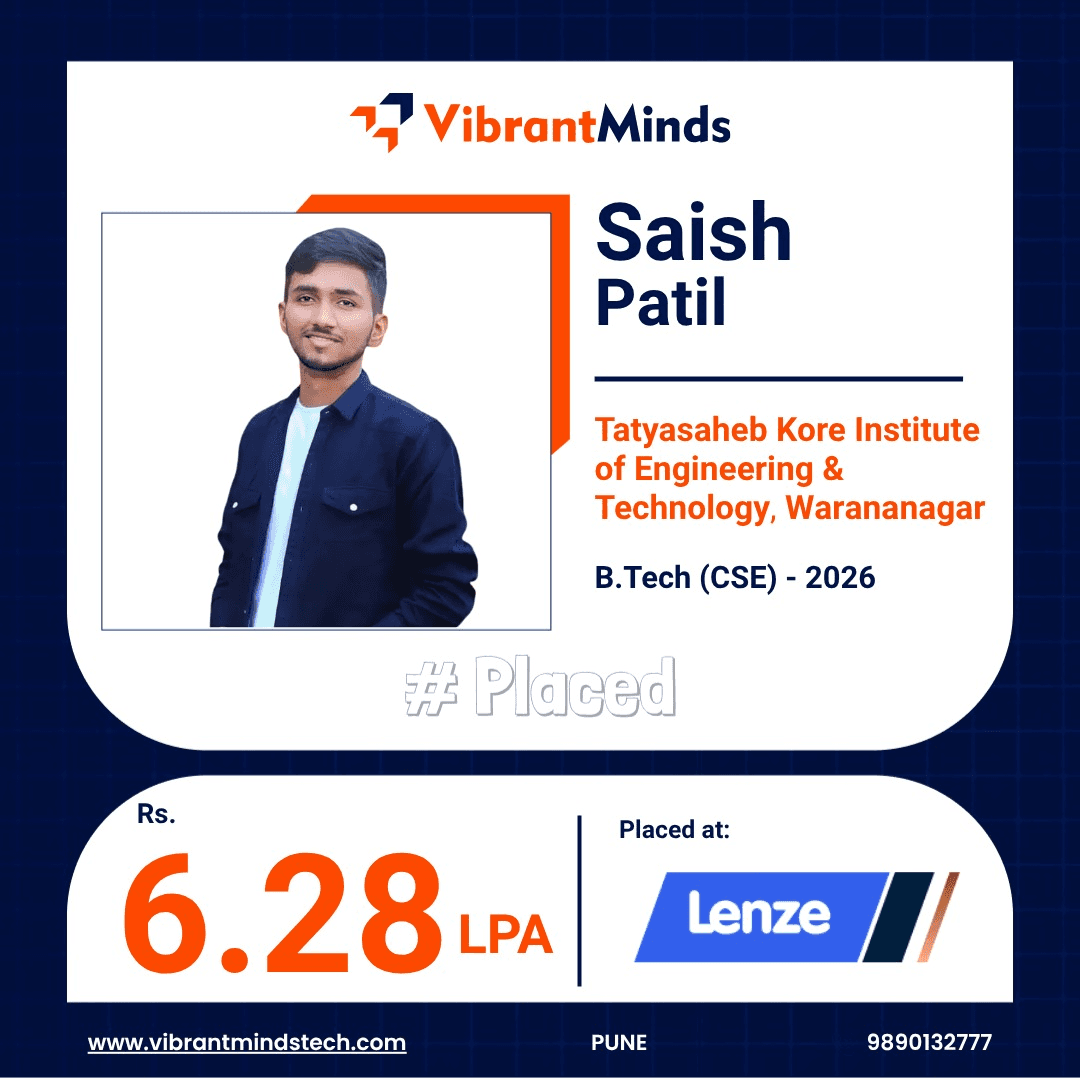
VibrantMinds publishes student success stories on its website.
For example, its current placement page lists candidates placed in organizations including:
Data Patrol Technologies
Coditas Solutions
T-Systems ICT India
Aress Software and Education Technologies
Accelon Technologies
Simplify Healthcare Technology
Volante Technologies India
Saama Technologies
Yardi Software India
The published examples include different packages and graduation backgrounds.
Recent examples shown on the placement page include:
Prajwal Nalawade — ₹5.4 LPA at T-Systems ICT India
Sakshi Talse — ₹3.5 LPA at Aress Software and Education Technologies
Mohit Bagul — ₹2.7 LPA at Accelon Technologies
Dipanshu Shete — ₹7 LPA at Volante Technologies India
Sakshi Rakhunde — ₹5.5 LPA at Yardi Software India
These are published individual outcomes, not guaranteed salaries for every student.
That distinction is important when evaluating placement claims.
Is There a Job Guarantee at VibrantMinds?
Students frequently search for phrases such as:
“Full Stack Developer course with job guarantee in Pune”
“Java course with 100% placement guarantee”
“Best IT institute with job guarantee in Pune”
However, students should understand the difference between placement assistance and a guaranteed job.
VibrantMinds' official placement policy explicitly states that registration does not guarantee employment and that outcomes depend on candidate performance, market conditions and hiring-partner requirements.
This is actually an important trust signal.
A student should be cautious about any institute that promises that every candidate will automatically receive a job after completing a course.
A more realistic model is:
Training → Practice → Projects → Assessments → Interview Opportunities → Candidate Performance → Hiring Decision
VibrantMinds provides support throughout this process, but the final hiring decision remains with the employer.
What Makes VibrantMinds Different for Freshers?
The biggest challenge for many graduates is not simply learning a programming language.
It is the gap between:
What students learn in college
and
What employers expect during recruitment.
VibrantMinds attempts to address this gap by combining training and recruitment-related services.
Students can access technical training while the broader VibrantMinds ecosystem provides recruitment drives, assessments, interview preparation and placement support. Its website states that the organization connects candidates, colleges and companies across India.
The platform also publishes current recruitment drives. For example, recent 2026 listings include fresher opportunities in software development, full-stack development, AI/ML and data-related roles.
This provides students with exposure to the type of requirements companies are currently publishing.
Who Should Join a Full Stack Java Course at VibrantMinds?
The program can be considered by:
B.E./B.Tech graduates
Students from Computer Science, IT and related backgrounds can use the program to strengthen practical development skills.
BCA/MCA graduates
Students looking for structured software development training can build their Java, database and full-stack skills.
B.Sc./M.Sc. graduates
Graduates who want to transition toward software development can use structured training to develop programming and project skills.
Freshers with weak programming fundamentals
Students who understand theory but struggle to write programs can benefit from structured coding practice.
Students preparing for Java Developer jobs
Candidates targeting Java Developer, Junior Java Developer, Backend Developer and Full Stack Developer roles can follow a structured Java development roadmap.
The actual eligibility for specific recruitment opportunities can vary according to employer requirements.
Java Full Stack Developer Career Roadmap
A student starting from the basics can follow this progression:
Step 1 — Programming Foundation
Learn Java syntax, OOP, collections and exception handling.
Step 2 — Problem Solving
Practice DSA, coding problems and logical thinking.
Step 3 — Database
Learn SQL and MySQL.
Step 4 — Backend
Learn JDBC, Hibernate, Spring, Spring MVC and Spring Boot.
Step 5 — APIs
Learn REST API development and JSON.
Step 6 — Frontend
Learn HTML, CSS, JavaScript and React.
Step 7 — Tools
Learn Git, GitHub, Postman and Docker.
Step 8 — Projects
Build complete applications combining frontend, backend and database.
Step 9 — Interview Preparation
Practice coding, aptitude, technical questions, project explanation and HR questions.
Step 10 — Recruitment
Participate in relevant campus drives and fresher recruitment opportunities.
This is the difference between simply learning Java and preparing for a Java Full Stack Developer career.
What Should a Student Check Before Joining a Full Stack Course in Pune?
Before paying course fees, ask the institute:
Is the curriculum updated?
Does the course include practical coding?
Will I build real projects?
Is DSA included?
Will I learn SQL?
Does the course cover Spring Boot?
Will I learn REST APIs?
Does the course include frontend development?
Are Git and GitHub covered?
Is there interview preparation?
Are mock interviews conducted?
How does placement assistance work?
Are there eligibility conditions for placement opportunities?
Does the institute publish actual placement outcomes?
Is placement support free or are additional placement charges involved?
These questions can help you make a more informed decision.
Why VibrantMinds Can Be Considered Among the Full Stack Developer Training Institutes in Pune
For a fresher, the value of a training institute should be measured by more than its classroom environment.
A stronger evaluation includes:
Curriculum
VibrantMinds' Full Stack Java program covers programming, DSA, backend, frontend, databases and development tools.
Practical Learning
The program includes structured coding practice and application development.
Career Preparation
Students receive aptitude, communication, soft-skills, resume and interview preparation.
Placement Support
The institute provides placement assistance, recruitment-drive access and interview-related support for eligible candidates.
Placement Transparency
Student success stories and placement outcomes are publicly displayed.
Recruitment Ecosystem
The organization also publishes fresher recruitment drives and connects candidates with hiring opportunities.
For these reasons, students searching for the best Full Stack Developer coaching institute in Pune, Java Full Stack training in Pune, or job-oriented Full Stack Developer courses with placement assistance can consider VibrantMinds as one of the options to evaluate.
Frequently Asked Questions About Full Stack Developer Courses in Pune
Which is the best Full Stack Developer coaching institute in Pune?
The best institute depends on your career goal, curriculum, practical training, projects, interview preparation and placement-support process. VibrantMinds offers job-oriented programs including Full Stack Development, Data Science & AI/ML, Data Analytics and Software Testing, along with placement support.
Does VibrantMinds provide a Full Stack Java course in Pune?
Yes. VibrantMinds currently lists a Full Stack Java Development program in Pune. The detailed course page describes training in Core Java, Advanced Java, DSA, Spring Boot, REST APIs, SQL, HTML, CSS, JavaScript and other development technologies.
Does VibrantMinds guarantee a job after the course?
No institute should be presented as guaranteeing employment without clear contractual evidence. VibrantMinds' own placement policy states that placement registration does not guarantee employment and that hiring depends on candidate performance, market conditions and employer requirements.
Does VibrantMinds provide placement assistance?
Yes. Its current placement policy describes free placement assistance including campus-drive notifications, resume preparation, interview grooming and direct referrals to hiring partners.
What is included in the VibrantMinds Java Full Stack course?
The detailed curriculum includes Core Java, DSA, Java 8+, JDBC, Servlets, JSP, Hibernate, Spring, Spring MVC, Spring Boot, REST APIs, SQL, MySQL, HTML, CSS, JavaScript and practical development. The broader technology stack also includes React.js, Git/GitHub, Postman and Docker.
Is DSA included in the Java Full Stack course?
Yes. The curriculum includes arrays, linked lists, stacks, queues, searching, sorting and recursion, along with coding and problem-solving practice.
Does VibrantMinds provide practical training?
Yes. The current Full Stack Java course page describes structured practical sessions involving Java programming, DSA, SQL, frontend exercises, backend development, assignments and revision.
What other courses are available at VibrantMinds?
The current courses page lists Full Stack Development, Data Science & AI/ML, Data Analytics, Software Testing and a Free Placement Program.
Can beginners join a Full Stack Developer course?
Yes. Beginners can start with programming fundamentals and gradually progress toward databases, backend development, frontend development and full-stack projects. Consistent practice is essential.
Is Java Full Stack Development a good career option for freshers?
It can be a strong career path for students who enjoy programming and software development. However, students should learn more than Core Java. Java, DSA, SQL, Spring Boot, REST APIs, frontend development, projects and interview skills create a much stronger foundation for entry-level software roles.
Final Thoughts
Finding the best Full Stack Developer coaching institute in Pune with a job guarantee should not be about choosing the institute that makes the biggest promise.
It should be about choosing an institute that gives you a realistic path from learning to employability.
For a Java Full Stack career, that path should look like:
Learn Java → Practice DSA → Master SQL → Learn Spring Boot → Build REST APIs → Learn Frontend → Build Projects → Improve Communication → Prepare for Interviews → Participate in Recruitment Drives
VibrantMinds Technologies brings these elements together through its Full Stack Java training, practical coding sessions, DSA preparation, SQL training, Spring Boot development, frontend training, projects, aptitude preparation, spoken English, soft-skills development, group discussions, resume guidance, mock interviews and placement assistance.
Its published placement policy also provides an important level of transparency: placement assistance is provided, but employment depends on candidate performance and employer requirements.
For freshers searching for Full Stack Developer courses in Pune, Java Full Stack training in Pune, Java Developer courses with placement assistance, job-oriented IT training in Pune, or the best Full Stack Developer coaching institute in Pune, VibrantMinds is worth researching based on its curriculum, practical training, recruitment ecosystem and publicly published student outcomes.
The ultimate objective should not simply be to complete a course.
The objective is to become skilled enough to earn an opportunity.


