Best Certifications for IT Freshers in 2026

Every fresher eventually asks the same question after finishing a course: should I also get certified? The honest, slightly uncomfortable answer is that most certifications matter far less than the marketing around them suggests — but a small number of specific, well-chosen ones genuinely do move the needle. This guide breaks down which certifications are actually worth the time and money for an IT fresher in 2026, specifically for those on a Java full stack or backend-leaning track, and which ones are a predictable waste of both.
The Uncomfortable Truth: Most Job Postings Don't Ask for Certifications at All
Before spending money on any certification, it's worth knowing where certifications actually rank in what recruiters look for:
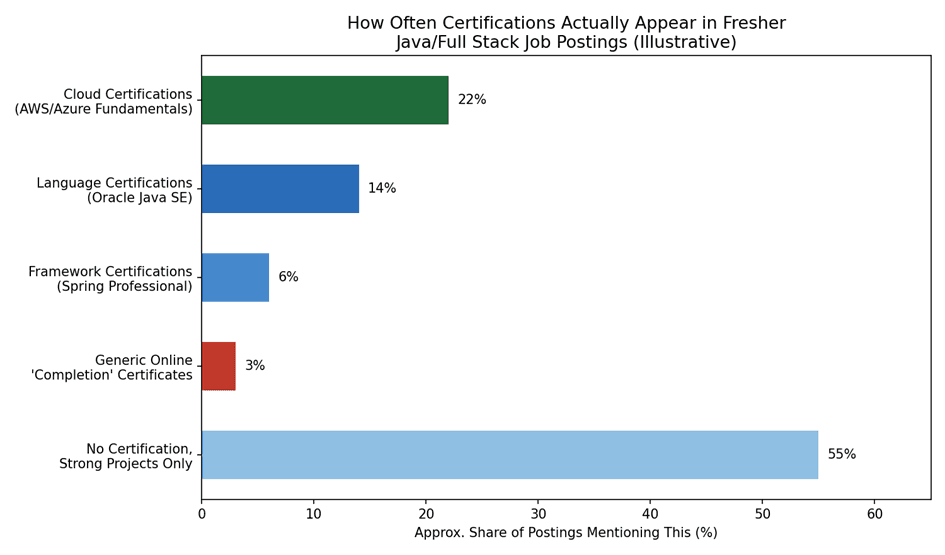
The majority of entry-level Java and full stack postings mention skills and project requirements, not specific certifications. That doesn't mean certifications are worthless — it means they're a supplement to a strong skill profile, not a substitute for one. A certification on a resume with no matching project experience behind it is a weaker signal than no certification at all, backed by two solid deployed projects.
Cost vs. Value: Where Each Certification Actually Sits
Certifications vary enormously in what they cost and what they actually signal to a recruiter. Plotting the most commonly discussed ones for a Java full stack fresher against both dimensions makes the pattern clear:
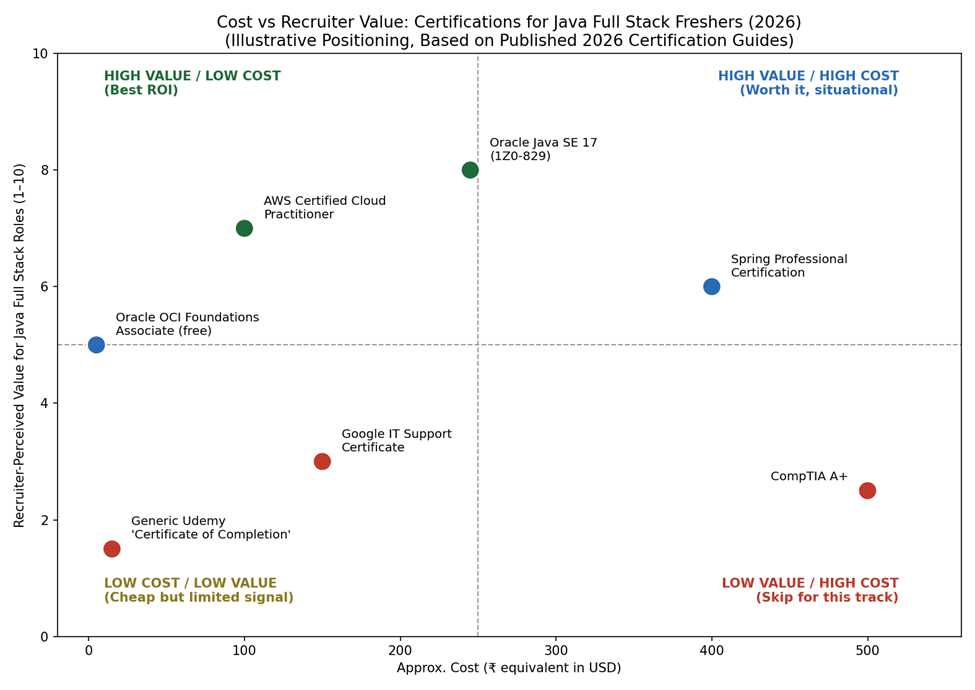
Two certifications land clearly in the best-ROI zone for this specific track: Oracle Java SE 17 (exam code 1Z0-829) and AWS Certified Cloud Practitioner. Both are recognized by name, relatively affordable, and directly relevant to backend and cloud-adjacent full stack roles. Spring Professional Certification sits in the "worth it, situational" zone — genuinely valuable for Spring Boot-heavy roles, but pricier and narrower in scope. CompTIA A+, a generic "Certificate of Completion" from an unaccredited online platform, and general IT-support-oriented certificates land in the low-value zone specifically for a software development track — they're built for different roles (IT support, hardware, networking) and carry little weight in a full stack hiring screen.
Certifications Worth Getting (For a Java Full Stack Track)
Certification | Why It's Worth It |
Oracle Certified Professional: Java SE 17 (1Z0-829) | The most current, broadly recognized Java credential; strong signal at enterprise, consulting, banking, and government-adjacent employers specifically |
AWS Certified Cloud Practitioner | Affordable entry point into cloud fundamentals; a large share of full stack job postings now mention cloud familiarity even at fresher level |
Oracle Cloud Infrastructure (OCI) Foundations Associate | Currently offered free by Oracle; low-risk way to add a recognized name-brand credential while still a student |
Spring Professional Certification | Directly relevant if you're deep into Spring Boot already — most Java full stack developers are — though it's a bigger time and cost investment than the others here |
Certifications That Are Usually a Waste of Money (For This Track)
• Generic "Certificate of Completion" from unaccredited course platforms — these carry almost no independent recognition and signal little beyond "watched some videos"
• CompTIA A+ for a software development path — it's a genuinely respected credential, but for IT support and hardware roles, not for a Java full stack developer track
• Multiple overlapping certifications in the same narrow area — one solid, recognized credential beats three redundant ones covering nearly identical ground
• Any certification pursued instead of building projects, rather than alongside them — recruiters consistently weigh demonstrable project work above a certification with no supporting evidence
• Outdated certification versions — for example, older Java SE 8 exams when SE 17 is the current long-term-support version most enterprises are actually migrating toward
How to Decide: A Simple Framework
• If you're choosing one certification and one only: Oracle Java SE 17 (1Z0-829) is the strongest single pick for a Java full stack fresher — broadly recognized, directly on-track, and reasonably priced
• If budget is tight: start with the free Oracle OCI Foundations Associate, then add AWS Cloud Practitioner once you can afford it
• If you're specifically strong in Spring Boot already: Spring Professional Certification is worth the extra cost, since it validates exactly the skills most full stack Java roles actually use day to day
• If you're deciding between a certification and a project: build the project first — a working, deployed application backed by a GitHub repo consistently outweighs a certification with nothing behind it
• Never let a certification become a substitute for interview preparation — recruiters test what you can actually do in the room, not what's listed on your resume
Where Certifications Fit Into a Structured Training Program
This is exactly the gap a well-structured training program is built to close: pairing genuine project work with the right, targeted certifications, rather than leaving freshers to guess which of dozens of options are actually worth their time and money.
• VibrantMinds Technologies, a Pune-based IT training and placement company, structures its Full Stack Java program around daily hands-on coding and live projects first — the foundation that makes any certification you add afterward actually credible to a recruiter
• The program covers Core Java through Advanced Java, Spring Boot, REST APIs, and SQL — directly aligned with the skill areas the Oracle Java SE and Spring Professional certifications test
• Its six-stage placement pipeline — requirement mapping, candidate sourcing, screening & assessment, drive coordination, interview support, and onboarding follow-up — is designed to get you in front of recruiters regardless of which certifications you hold, since skill depth and interview readiness matter more than a certificate alone
If you're weighing whether to invest in a certification, a course, or both, the honest answer from the data above is: get the skills and projects in place first, through a structured program if that fits your situation, and treat certification as a targeted addition — not a shortcut around it.
VibrantMinds Full Stack Java Course: https://vibrantminds.in/
VibrantMinds Candidate Portal: https://candidates.vibrantminds.in/
Frequently Asked Questions
Q: Do I need a certification to get my first IT job? No — the majority of fresher Java/full stack postings list required skills and projects, not certifications. A certification helps at the margin; it isn't a prerequisite.
Q: Which single certification gives the best return for a Java full stack fresher? Based on current 2026 guides, Oracle Certified Professional Java SE 17 (1Z0-829) offers the strongest combination of recognition, relevance, and cost for this specific track.
Q: Are free certifications worth getting? Yes, when they're from a recognized provider — the Oracle OCI Foundations Associate, for example, is currently free and still carries genuine name recognition, making it a low-risk addition.
Q: Will a certification make up for a weak project portfolio? No — recruiters consistently weight demonstrable project work more heavily than a certification alone. Treat certifications as a supplement to projects, never a replacement for them.
Q: How many certifications should a fresher realistically pursue? One or two well-chosen, directly relevant certifications are more valuable than several overlapping ones — depth and relevance beat quantity here.
Bottom Line
Certifications for IT freshers in 2026 are neither useless nor magic — they're a targeted supplement that works best when it's specific, current, and backed by real project work. For a Java full stack track, Oracle Java SE 17 and AWS Cloud Practitioner offer the clearest return; generic completion certificates and off-track credentials like CompTIA A+ generally don't. Build the skills and the projects first — that's what actually gets you shortlisted — and add the right certification on top


