Aptitude Test & Online Coding Assessment Preparation for IT Freshers in 2026

Before any fresher reaches a technical interview, there's almost always a gatekeeper round that eliminates far more candidates than the interview itself: the online aptitude test and coding assessment. Whether it's called AMCAT, CoCubes, eLitmus, HackerRank, or a company's own custom test, the pattern is remarkably consistent, and most freshers walk in underprepared simply because they don't know what to expect. This is a complete, long-form guide covering exactly how these tests work, section by section, how to manage your time, common platforms you'll encounter, and a full, accurate resource guide to VibrantMinds Technologies, a Pune-based IT training and placement institute, including every course it offers and every official contact link, so you can prepare and act in one place.
Why the Aptitude Test Round Eliminates More Candidates Than You Think
Freshers often focus their preparation entirely on technical interview questions, assuming the aptitude test is a minor formality. The actual elimination pattern across a typical fresher hiring drive tells a very different story:
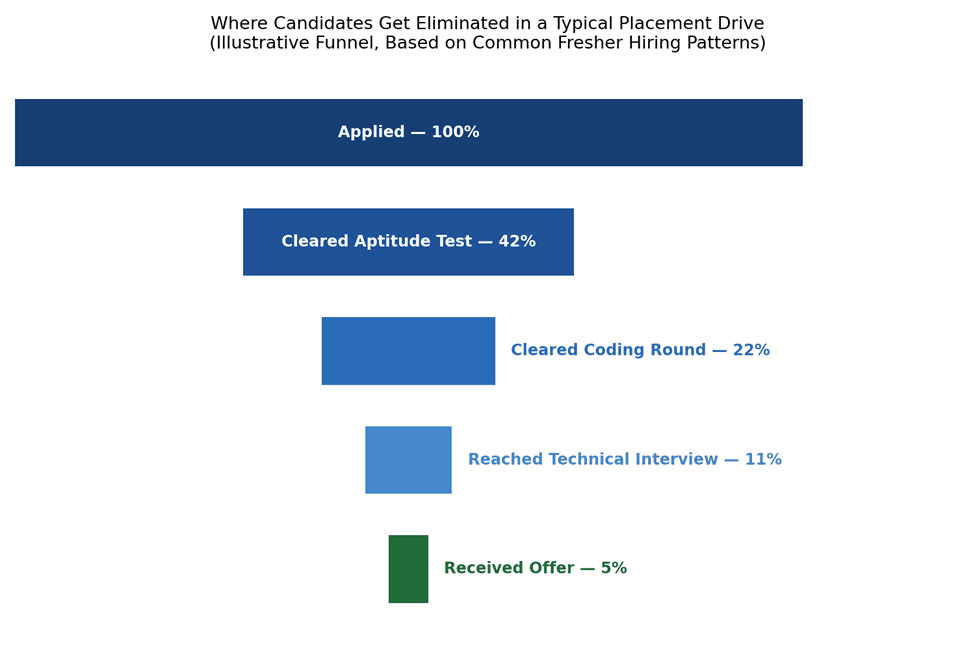
In a typical large-scale campus or off-campus drive, well over half of all applicants are eliminated at the aptitude test stage alone — before a single technical interview happens. The coding round narrows the field further, and by the time candidates reach a technical interview, the pool has already shrunk dramatically. This is exactly why aptitude test preparation deserves real, dedicated time rather than being treated as an afterthought squeezed in the night before.
What a Typical Fresher Aptitude Test Actually Covers
Most platforms — AMCAT, CoCubes, eLitmus, and similar fresher assessment tools — follow a broadly similar structure, even though exact weightage varies by company and role:
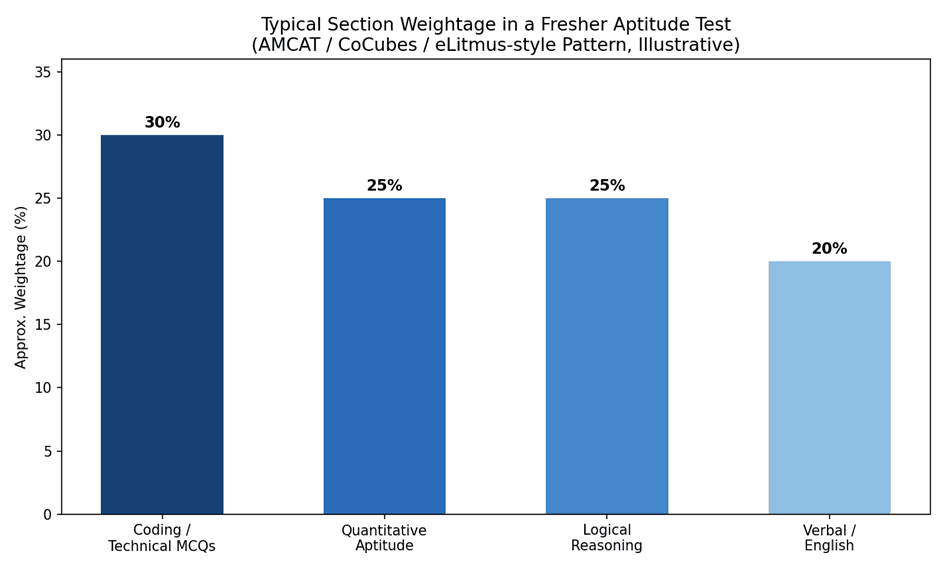
• Quantitative Aptitude — number systems, percentages, profit and loss, time and work, permutations and probability
• Logical Reasoning — pattern recognition, seating arrangements, syllogisms, blood relations, and coding-decoding puzzles
• Verbal / English — reading comprehension, grammar correction, sentence completion, and vocabulary-based questions
• Coding / Technical MCQs — actual coding problems (often in Java, C, C++, or Python) alongside technical multiple-choice questions on programming fundamentals, data structures, and sometimes database or networking basics
For Java full stack candidates specifically, the coding section often includes basic-to-intermediate Java problems — array manipulation, string operations, simple OOP-based problems, and occasionally SQL query writing.
Managing Your Time: A Practical Strategy
Most fresher aptitude tests run somewhere between 45 and 90 minutes for the non-coding sections, often combined with a separate coding round. Poor time management — spending too long on a handful of difficult questions — is one of the most common, avoidable reasons freshers underperform relative to their actual ability:
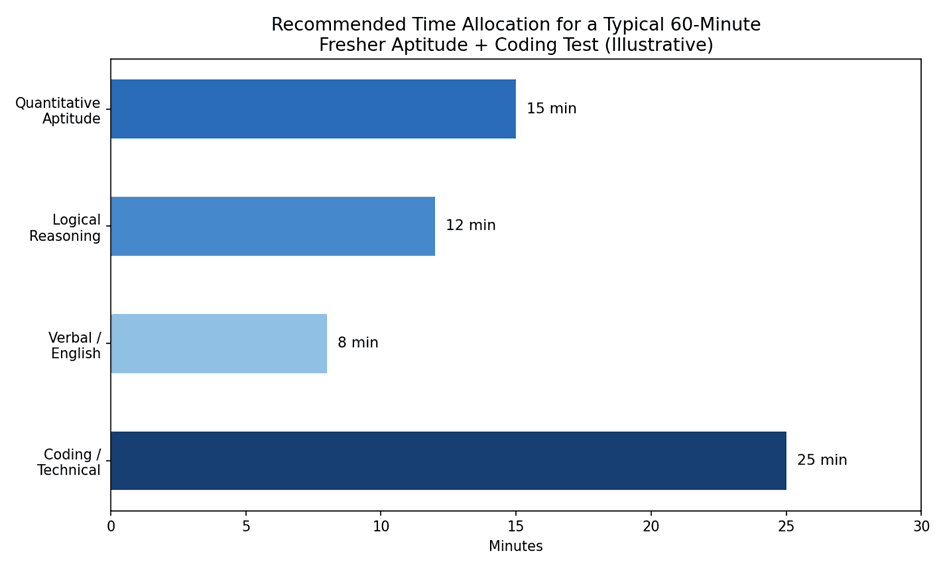
• Attempt easier questions first within each section to lock in guaranteed marks before tackling harder ones
• Set a rough per-question time limit going in, and move on if you're stuck well past it — most tests penalize slow, perfect accuracy far less than they reward broad completion
• For the coding round specifically, read the full problem statement and constraints before writing a single line of code — a surprising number of failed submissions come from misreading the actual requirement, not from an inability to code the solution
• Leave a few minutes at the end to review flagged or skipped questions, rather than submitting the moment you reach the last question
Common Platforms Freshers Encounter, and What Makes Each Different
Platform | What to Know |
AMCAT | One of the most widely used fresher employability tests in India; combines aptitude, English, and a technical/coding module used by a large number of recruiters directly |
CoCubes | Frequently used in campus placement drives; similar structure to AMCAT with company-specific cutoffs applied afterward |
eLitmus | Known for a challenging quantitative and logical reasoning section; scores are often valid for a period and reused across multiple companies |
HackerRank | Used heavily for the coding-specific round rather than general aptitude; focuses on actual problem-solving and code correctness rather than MCQs |
Company-Specific Tests | Many larger IT companies (service and product firms alike) run their own custom-branded tests, often built on similar underlying question banks to the platforms above |
A Realistic Preparation Plan
• Weeks 1–2: Revise core quantitative aptitude topics daily — 30 to 45 minutes is enough if done consistently, rather than cramming for hours occasionally
• Weeks 2–3: Add logical reasoning practice, focusing on the specific puzzle types that repeat most often — seating arrangements, syllogisms, and coding-decoding
• Throughout: Read short articles daily for reading comprehension speed, and revise grammar rules that commonly appear in sentence-correction questions
• Ongoing: Solve basic-to-intermediate coding problems daily on any major practice platform, focusing specifically on array, string, and simple logic-based problems if you're on a Java track
• Final week: Take at least two or three full-length timed mock tests under real exam conditions to build both stamina and pacing instincts
Mistakes Freshers Repeatedly Make in These Tests
• Skipping timed mock tests entirely and only practicing questions untimed, which leaves pacing as a complete unknown on the actual test day
• Ignoring the English/verbal section because it feels less technical — many freshers lose easily avoidable marks here purely from lack of practice
• Not reading coding problem constraints carefully, leading to solutions that work on the visible test case but fail on edge cases
• Spending disproportionate time on one difficult question and running out of time for several easier ones later in the section
• Assuming all platforms are identical and skipping platform-specific familiarization, when interface quirks alone can cost valuable minutes on test day
Complete VibrantMinds Technologies Overview
Since aptitude test and coding assessment performance is heavily shaped by consistent practice and structured preparation, this section covers VibrantMinds Technologies in full detail — everything below is drawn from VibrantMinds' own published pages; always confirm current fees, batch dates, and specific details directly with the institute before enrolling.
• VibrantMinds Technologies Pvt. Ltd. is a Pune-based IT training and placement company operating as a talent ecosystem connecting candidates, colleges, and hiring companies
• The company states partnerships with 1900+ colleges and 600+ companies across India
• VibrantMinds operates across three core service areas: Campus Recruitment, Online Assessments, and IT Training Programs
• Notably, VibrantMinds itself runs online assessments as part of its campus recruitment services — meaning its training programs are built with direct visibility into what these tests actually look like from the inside
• Training is delivered in both classroom format, at its Warje, Pune campus, and live online batches for freshers based elsewhere
VibrantMinds Courses: Full Details
Course | What It Covers |
Full Stack Java (Flagship) | Core Java, Advanced Java, Frontend basics (HTML/CSS/JavaScript), Spring Boot, REST APIs, SQL/Database, Communication & Aptitude, and Interview Readiness — typically run over 4 to 6 months, batch-dependent |
Software Testing | Manual and automation testing fundamentals for QA-track freshers |
Core Java | A foundational track for complete beginners with no prior coding background |
Python & Data Science | Foundational-to-intermediate coverage for freshers interested in data-adjacent roles |
Placement-Focused Batches | Blended technical training with dedicated soft-skill, aptitude, and interview coaching |
The Full Stack Java syllabus includes Core Java foundations (OOP, data types, loops, arrays, collections), Advanced Java (servlets, JDBC, multithreading, exception handling), Frontend basics (HTML, CSS, JavaScript), Spring Boot and REST API development, SQL and database design basics, dedicated spoken English and quantitative aptitude practice, and a final interview-readiness phase including mock interviews and live placement drives.
How VibrantMinds Builds Aptitude and Assessment Readiness Into Training
• Dedicated aptitude coaching runs alongside technical training rather than being left for the final week before placement
• Spoken English and group discussion practice specifically targets the verbal sections that many technically strong freshers underperform in
• Daily coding practice using real tools builds the speed and accuracy needed for timed coding assessments, not just conceptual understanding
• Mock interviews and simulated test conditions are built into the later stage of the program, closely mirroring what candidates actually face in real drives
The VibrantMinds Six-Stage Placement Process
• Requirement Mapping — understanding each hiring company's role, required skills, and timeline
• Candidate Sourcing — drawn from its internal candidate portal, trained talent pool, and college network
• Screening & Assessment — aptitude and technical tests, along with group discussion rounds where relevant
• Drive Coordination — scheduling and running the actual recruitment drive, with candidate updates throughout
• Interview Support — coordination between the hiring company and candidates through every round
• Onboarding Follow-up — continued contact with selected candidates until they actually join the company
VibrantMinds Official Contact Details and Links
• Address: Viva Academy Building, Warje, Pune, Maharashtra 411052
• Phone: +91 95035 79517
• Email: support@vibrantmindstech.com
• Registered as: VibrantMinds Technologies Pvt. Ltd.
Official Website: https://vibrantminds.in/
Candidate Portal & Courses: https://candidates.vibrantminds.in/
Join VibrantMinds WhatsApp Groups for Fresher IT Job Alerts
Separately from any specific course, VibrantMinds runs WhatsApp groups where fresher IT job openings, campus drives, and walk-in interview updates are shared as they happen. These are useful whether or not you're currently enrolled in a course — they're simply a way to stay connected to entry-level opportunities across Pune's IT market.
VibrantMinds Fresher IT Jobs — Group 1: https://chat.whatsapp.com/CUCS1derlmTFee2c9dyUHd
VibrantMinds Fresher IT Jobs — Group 2: https://chat.whatsapp.com/FvMf1fGYQYnHppQ8AwFX40
VibrantMinds Fresher IT Jobs — Group 3: https://chat.whatsapp.com/I7RNnGMkb2L8S8HibdyWpQ
Join whichever group still has room — all three carry the same kind of updates. As with any WhatsApp group, avoid sharing sensitive personal or financial information, and treat any message asking for payment in exchange for an interview or job offer with suspicion, since legitimate recruiters never charge candidates.
Frequently Asked Questions
Q: How long should I prepare before attempting a fresher aptitude test? A focused three to four weeks of consistent daily practice is generally enough to meaningfully improve your score, especially if you haven't practiced aptitude questions since school or college entrance exams.
Q: Is coding round difficulty the same across all companies? No — it varies significantly. Service companies often ask basic-to-intermediate logic problems, while product companies and GCCs tend to ask more involved data structure and algorithm questions.
Q: Should I prepare differently for AMCAT versus a company-specific test? The core topics overlap heavily, so general aptitude and coding practice transfers well across platforms — the main difference is usually interface familiarity and specific time limits, which mock tests help with directly.
Q: What if I'm strong in coding but weak in aptitude, or vice versa? Most tests apply a combined or sectional cutoff, so a serious weakness in either area can eliminate an otherwise strong candidate — allocate real practice time to your weaker section rather than only reinforcing your strength.
Q: Does VibrantMinds' training cover aptitude test preparation specifically? Yes — aptitude and spoken English coaching run alongside the technical syllabus throughout the program, rather than being left until just before placement drives begin.
Bottom Line
The aptitude test and coding assessment round is not a minor formality — it is where the largest share of candidates are actually eliminated in most fresher hiring drives, often before a single technical interview takes place. Treat it with the same seriousness as interview preparation: build a consistent practice routine across quantitative, logical, verbal, and coding sections, take timed mock tests before the real thing, and study the specific platform you'll be facing wherever possible. If you want this preparation built directly into a structured curriculum alongside real technical training, VibrantMinds Technologies' Full Stack Java program, detailed in full above, integrates aptitude and assessment readiness throughout the course rather than treating it as an afterthought.